


Co-Founder

Front-end web development makes a website visually engaging and user-friendly. It helps build responsive websites, interactive features, and optimise user experiences for desktop and mobile platforms, enabling users to navigate seamlessly across devices.
The best frameworks for front-end web development include React, Angular, Vue.js, Svelte, Next.js, and Nuxt.js. These frameworks help focus development by providing pre-built functions and components that developers can use to build responsive, dynamic websites.
The programming languages used for front-end web development include HTML, CSS, JavaScript, TypeScript, Dart, JSX, and SASS/SCSS. These languages are important for creating structured, styled, and interactive user interfaces on the web.
To develop the front-end of a website, steps to follow include planning and designing, coding the structure, adding interactivity with JavaScript, testing, and deploying the website. These structured processes are carried out to ensure the website loads quickly and provides a smooth user experience.
According to a report by Clutch titled "2023 Web Development Industry Survey," published in Clutch (2023), there are over 4.5 million front-end developers globally, responding to the growing demand for interactive web design and mobile responsiveness.
Front-end web development refers to the creation of the visual and interactive aspects of a website or web application. This includes everything the user interacts with directly in the browser, such as the layout, design, and functionality. It involves using a combination of programming languages, frameworks, and tools to build responsive, user-friendly, and accessible websites.
According to a report by the National Association of Software and Services Companies (NASSCOM), titled "Global Software Development Trends," 2023, the number of front-end developers globally continues to grow, with millions of developers working in this field to meet increasing demand for interactive and mobile-responsive websites.
Front-end development is important because it shapes the user's experience and determines how a website functions on different devices and browsers. Good front-end development ensures that websites load quickly, are easy to navigate, and provide a smooth experience across various platforms.
Use cases for front-end web development include building e-commerce websites, blogs, social media platforms, and enterprise-level applications that rely on user interaction.
A front-end web developer is a professional who specialises in creating the client-side of websites and web applications. Their role is to build the parts of a website that users interact with directly, ensuring the site is visually appealing, responsive, and functional across devices and browsers.
Front-end web developers work with technologies like HTML, CSS, JavaScript, and various frameworks to design, implement, and optimise websites. They ensure that all visual elements of the website work seamlessly and are accessible to users. Their tasks often include translating design mockups into code, developing interactive features, and troubleshooting issues related to performance or user experience.
A front-end web developer should have a strong grasp of web design principles, knowledge of programming languages (HTML, CSS, JavaScript), and familiarity with frameworks and tools such as React, Angular, or Vue.js.
While a formal degree may not always be necessary, a degree in computer science or a related field, along with experience in web development projects, is highly valued. Understanding UI/UX design principles and keeping up with the latest trends in front-end development is critical for success in this role.
The best frameworks for front-end web development include React, Angular, Vue.js, Svelte, Next.js, and Nuxt.js. These frameworks simplify the process of building complex user interfaces by providing reusable components, enhanced performance, and better maintainability.
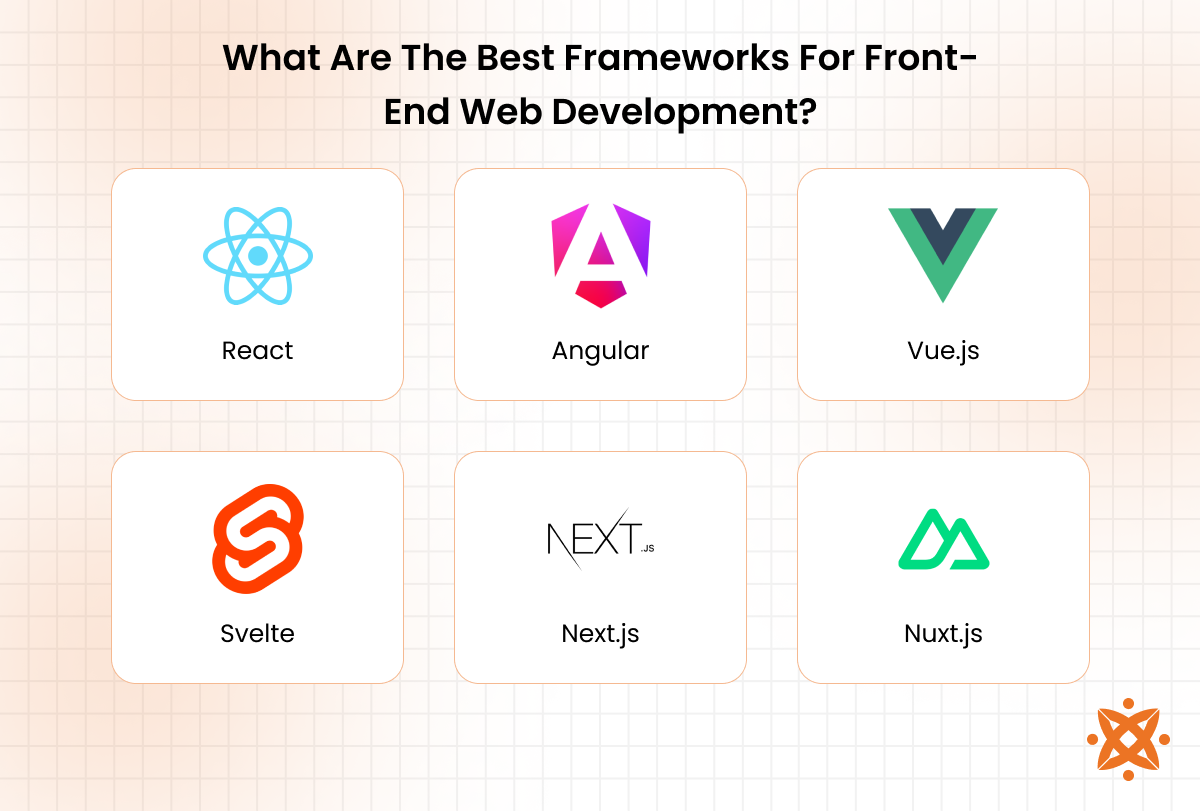
The best frameworks for front-end web development are explained below:
The programming languages used for front-end web development include HTML, CSS, JavaScript, TypeScript, Dart, JSX, and SASS/SCSS. These languages are fundamental in creating dynamic, interactive, and visually appealing websites. Below is a breakdown of each language.
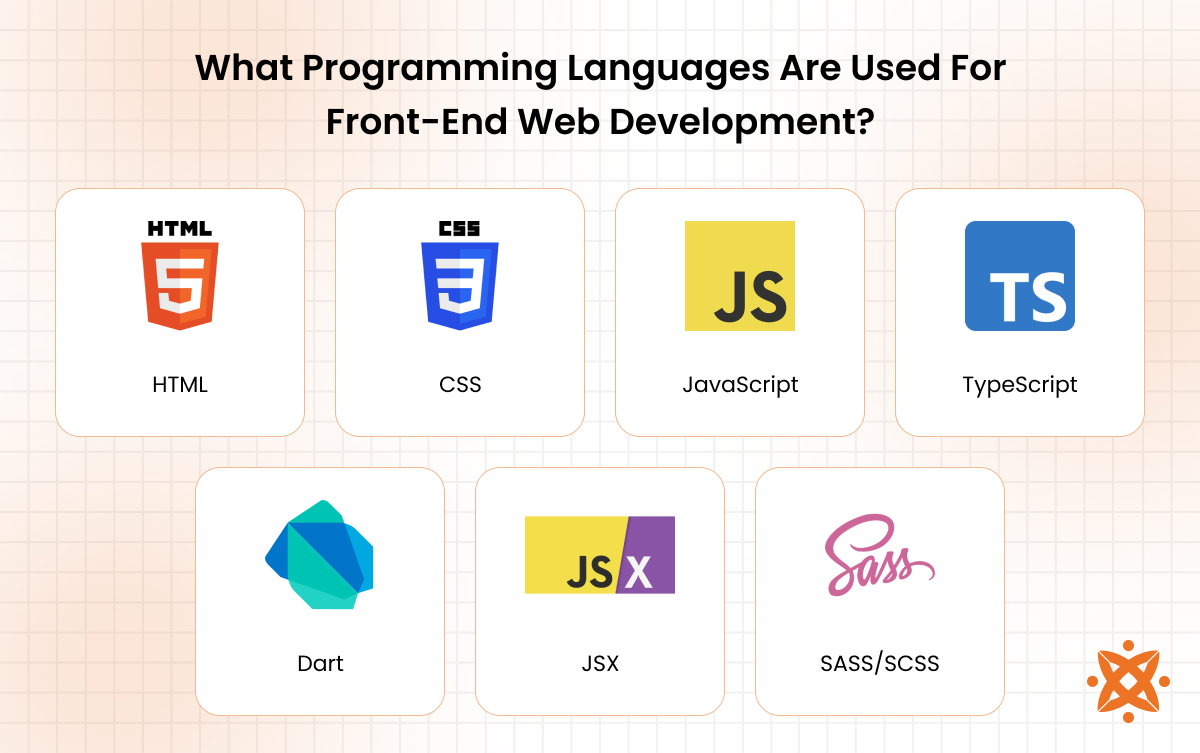
The programming languages used for front-end web development are:
To develop the front-end of a website, steps to follow include planning and designing, coding the structure, adding interactivity with JavaScript, testing, and deploying the website. These steps ensure the creation of a functional, visually appealing, and user-friendly website.
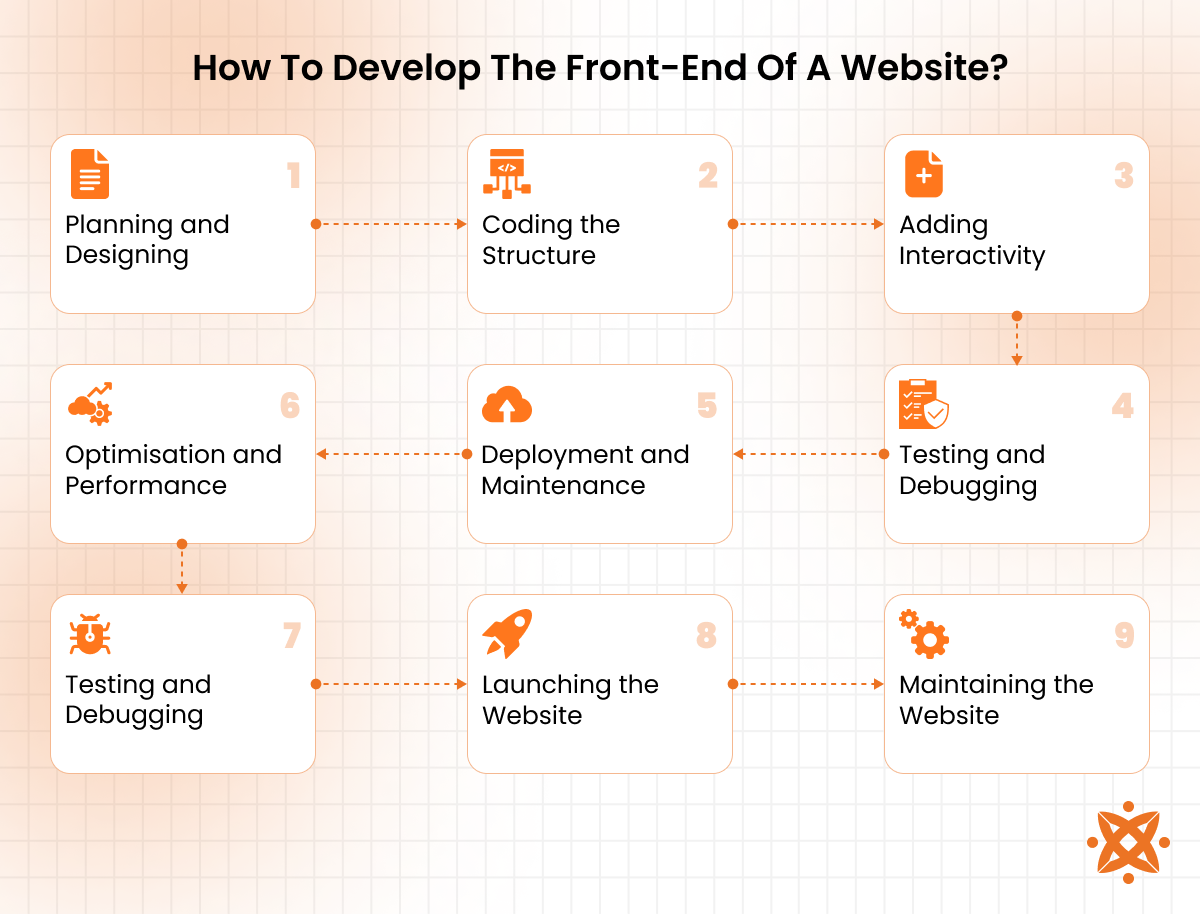
To develop the front-end of a website, the steps to follow are:
The first step in developing the front-end of a website is planning and designing. During this stage, you define the website's purpose, identify the target audience, and create a layout. Wireframes or mockups are often created to visualise the website structure before development begins.
This step also involves choosing colour schemes, fonts, and overall design elements that align with the website's goals. It is essential to prioritise user experience (UX) to ensure that visitors will have a smooth, intuitive interaction with the site.
The second step in front-end development is coding the structure of the website. This involves using HTML to create the basic structure, such as headings, paragraphs, and navigation. HTML serves as the foundation for the site and dictates how content is displayed.
Once the HTML structure is in place, CSS is used to style the page. CSS allows you to control the layout, colours, fonts, and overall design of the website, ensuring that it matches the mockups or wireframes created in the first step.
The third step is adding interactivity to the website, primarily through JavaScript. This step involves writing scripts that allow users to interact with the page, such as submitting forms, clicking buttons, or navigating through different sections without refreshing the page.
JavaScript is used to enhance the user experience by providing real-time updates and feedback. For example, animations, dynamic content loading, and user input validation all rely on JavaScript to create a responsive and engaging experience.
The next step is testing and debugging, which ensures that your website functions correctly across different devices and browsers. This phase involves checking for bugs, ensuring compatibility, and fixing any issues that may arise.
To perform effective testing, you use tools like browser developer tools, cross-browser testing tools, and performance testing tools. Debugging allows you to identify and resolve issues that could affect user experience, ensuring that the site is responsive and functional.
Once testing is complete, the next step is deployment, where the website is launched to a live server. This involves moving the website from a development environment to a production server, making it accessible to users worldwide.
Post-launch, the website requires continuous maintenance. This includes updating content, ensuring compatibility with new browsers, fixing any bugs, and improving performance. Regular maintenance keeps the website running smoothly and ensures it stays relevant over time.
After deployment, optimisation plays a crucial role in improving the website's performance. This involves tasks like reducing load times, optimising images, and improving server response times. Optimising a website enhances user experience and increases the likelihood of visitors staying longer.
Performance monitoring tools track the website's speed and identify areas for improvement. Regular optimisation ensures the website runs smoothly and efficiently, even as user traffic grows.
Testing and debugging ensure that the website functions as intended across different devices and browsers. This step involves checking for issues like broken links, incorrect formatting, and functionality problems. It's essential to use both manual and automated testing methods to uncover potential errors.
Once identified, debugging tools and techniques are applied to fix these issues. Thorough testing improves the overall quality and performance of the website, ensuring it meets user expectations.
Launching the website marks the transition from development to a live environment. This step involves setting up the website on a server and ensuring it is accessible to users. It's crucial to double-check all configurations and ensure that no errors remain before the site goes live.
After launch, it's important to monitor the website's performance and ensure it remains stable. Regular checks for broken links, slow load times, or security issues are necessary to keep the site running smoothly.
Website maintenance is essential to ensure the website stays up-to-date and secure. This involves regularly updating the content, fixing bugs, and implementing new features as needed. Keeping everything current ensures the user experience remains optimal and prevents security vulnerabilities.
Regular backups should also be done to prevent data loss. Performance monitoring tools can help identify any issues, such as slow loading times, and improve site functionality over time.
The main difference between front-end and back-end web development is that front-end focuses on the visual and interactive aspects of a website, while back-end deals with the server-side logic, databases, and overall functionality that supports the website.
Front-end development includes everything that users see and interact with, such as layout, buttons, and content. Back-end development handles data management, server configuration, and integration with databases to ensure the site's functionality.
In addition to these core distinctions, front-end developers are concerned with the aesthetics and usability of the website, while back-end web development focuses on the performance, security, and data structure behind the scenes. Back-end developers manage APIs, authentication, and server configurations, ensuring that the website's core features work as intended.
The main difference between front-end web development and web development is that front-end web development specifically focuses on the design, structure, and interactive aspects of a website, while web development encompasses both front-end and back-end development.
Front-end developers work on what users directly interact with, such as layout, content, and user experience. Web development, on the other hand, includes both the client-side (front-end) and server-side (back-end) aspects, which together create a fully functional website.
In addition to this primary difference, front-end web development is concerned with the user interface, usability, and visual design, while web development also includes tasks such as database management, server configuration, and API integration. Web development covers the entire scope of website creation, including both the user-facing and behind-the-scenes functionality that supports the website's operations.
To choose the right front-end web developer, the factors to consider are experience, skills, portfolio, communication, project management ability, collaboration, and adaptability. These elements ensure that you hire someone capable of building a website that aligns with your business goals and expectations.
To choose the right front-end web developer, the factors to consider are:
If you're looking for a reliable and skilled front-end web developer, consider Intelivita for your project. With years of experience, a proven track record, and a team of experts, Intelivita is one of the best providers of front-end web development services in London and nearby areas.
Our deep understanding of both design and functionality will ensure your website stands out and meets the highest standards. Let us help you build a dynamic, user-friendly website with top-tier front-end development expertise.
The average cost of front-end web development ranges from £1,000 to £30,000, depending on several factors such as the complexity of the project, the developer's experience, and the region. A simple website with a few pages will be at the lower end of the scale, while complex, dynamic websites with custom features or integrations can push the cost higher.
According to a report by Clutch titled "How Much Does Web Development Cost?", 2023, the average cost for a mid-range web development project in the UK ranges from £9,000 to £15,000.
Factors influencing the cost include the type of website, design elements, custom functionalities, and whether the project involves integrations with third-party services. Websites with advanced features such as e-commerce, interactive elements, or high traffic capacity require more extensive development and testing, which increases the cost. Moreover, the timeline and the need for ongoing support after launch can also impact pricing.
The best practices for front-end web development include clean code, responsiveness, performance optimisation, cross-browser compatibility, and version control. Adhering to these principles is vital for delivering high-quality websites that meet user expectations and business goals.
The best practices for front-end web development are:
The trends in front-end web development include the rise of Progressive Web Apps (PWAs), JavaScript frameworks, server-side rendering (SSR), motion UI, static site generators, design systems, and JAMstack. Staying updated with these trends helps developers enhance performance, improve design, and meet evolving user expectations.
The trends in front-end web development are explained below:
Sign up now and get notified when we publish a new article!
Co-Founder
Oliver Baker is a co-founder of Intelivita, a leading Web and Mobile App Development Company based in Leeds, UK. Oliver has been at the forefront of the business, expanding it globally and into new technologies including iOS and Android, AR, VR and Mobile Game applications. Oliver excels in Project Management, Leadership, Quality Assurance and Problem Solving and has qualifications with Prince2 and APM. He aims to develop his skills further through a shared interest with other leaders in the Software Markets and the Clients of Intelivita.
