


Co-Founder

Flutter is an open-source framework developed by Google for building high-performance, cross-platform applications. Using the Dart programming language, Flutter allows developers to create mobile and web applications from a single codebase. It provides a rich set of customisable widgets and tools that enable developers to design responsive user interfaces while ensuring native-like performance on both Android and iOS platforms.
According to a report by Statista titled “Cross-platform mobile frameworks used by software developers worldwide from 2019 to 2023”, Flutter is the most popular cross-platform framework, with over 2 million developers using it. Around 30-46% of app developers prefer Flutter, which has over 160,000 stars on GitHub and is highly ranked on Stack Overflow.
The core components of Flutter include its widget-based architecture, the Dart programming language, and the Flutter rendering engine. The framework provides a wide range of pre-built Material design components and custom widgets, allowing developers to create highly interactive and visually appealing user interfaces. The Flutter rendering engine ensures that apps run smoothly by directly rendering the UI, bypassing traditional native UI components, and achieving native performance across platforms.
Flutter enables cross-platform development by allowing developers to build applications that work on multiple platforms with a single codebase. The framework compiles code to native ARM or x86 machine code, ensuring high-performance apps with optimised responsiveness. This capability significantly reduces development time and effort while maintaining a consistent look and feel across iOS, Android, web, and desktop applications.
The best state management solutions for Flutter are Provider, Riverpod, and Bloc. These solutions allow developers to efficiently manage and share application state across widgets while maintaining a scalable and maintainable codebase. Depending on the project's complexity, developers choose the solution that best suits their needs, whether it's a simple approach with Provider or a more advanced reactive framework like Bloc.
Flutter app development involves building applications using the Flutter framework to create high-performance, cross-platform solutions. Developers use the Dart programming language to write code, using Flutter's hot reload feature to speed up the development process. Designing custom widgets and utilising Flutter's flexible architecture allows developers to create mobile and web applications optimised for native performance, ensuring an impressive user experience across all platforms.
Flutter is an open-source UI software development kit (SDK) developed by Google. It is used to build natively compiled applications for mobile (iOS, Android), web, and desktop (Windows, macOS, Linux) from a single codebase. Flutter enables developers to create high-performance, visually appealing applications with expressive and flexible user interfaces. It uses the Dart programming language and includes a rich set of pre-designed widgets that support smooth animations and a consistent look and feel across platforms.
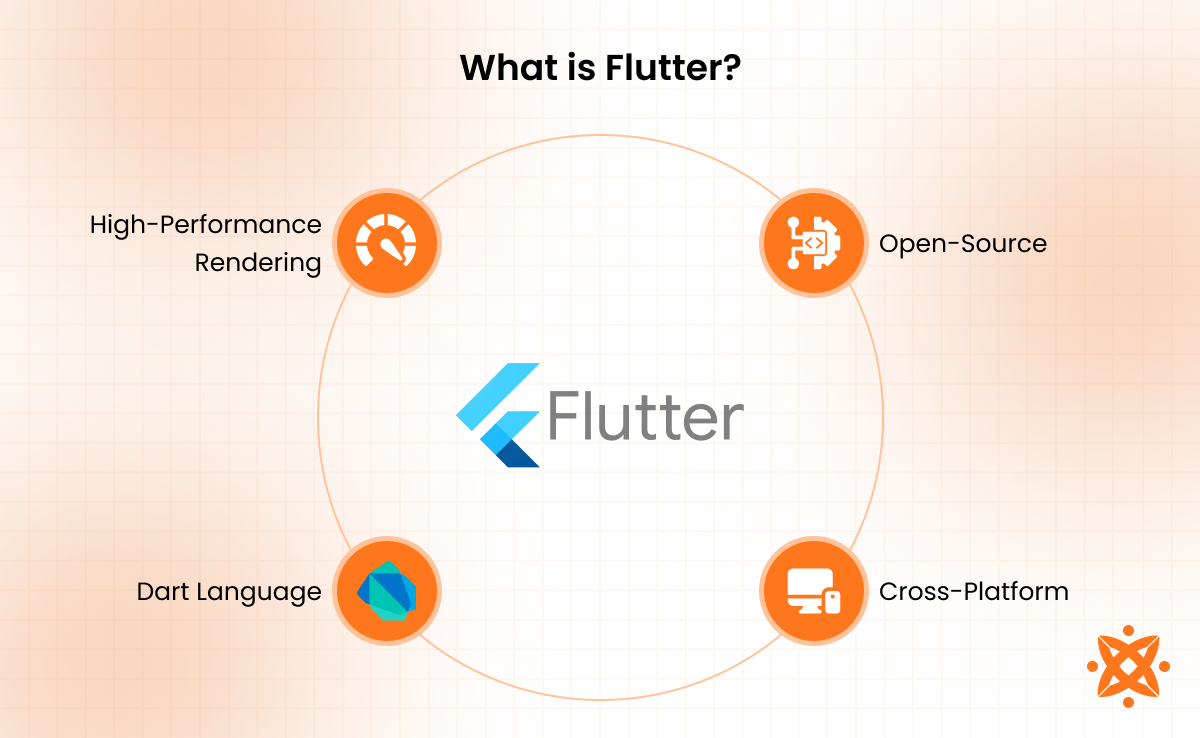
Flutter operates using a unique architecture. It employs a high-performance rendering engine, Skia, to draw its user interfaces directly onto the screen rather than relying on platform-specific components. The framework uses its widget-based system, where everything is treated as a widget, from structural elements like buttons to stylistic elements like fonts. Developers write their application logic in Dart, and Flutter compiles it into native ARM or x86 code for efficiency.
Google first announced Flutter at its Dart Developer Summit in 2015, initially under the codename "Sky." It was designed to render consistent 120 frames-per-second (FPS) graphics directly in a web browser. In December 2018, Google officially released Flutter 1.0, marking its readiness for production use. Since then, Flutter has seen continuous development, with updates introducing support for additional platforms, improved tooling, and better performance.
Flutter was created by Google and is maintained by the company alongside a growing community of open-source contributors. Google designed Flutter to address the need for a unified development framework that delivers native experiences across multiple platforms with a single codebase. It is also the foundation for the user interface of Google's Fuchsia operating system.
According to the Stack Overflow Annual Developer Survey titled “Stack Overflow Developer Survey,” around 13% of developers use Flutter in 2023, making it one of the top choices for mobile app development. Flutter's popularity has grown significantly due to its ability to reduce development time and costs while delivering high-quality applications. Companies like Alibaba, eBay, and BMW have used Flutter to build their apps, showcasing its reliability in both small-scale and enterprise-level projects.
No, Flutter is not a programming language. It is a framework for building cross-platform applications. Flutter writes its code using the Dart programming language created by Google. As a software development kit (SDK), Flutter provides tools, pre-built widgets, and rendering engine developers use to develop high-performance and visually appealing applications.
While Dart handles the logic and syntax of the application, Flutter's framework simplifies the process of designing and implementing user interfaces across different platforms.
Flutter is used to create cross-platform applications. It allows developers to write a single codebase that compiles native applications for mobile (iOS and Android), web, and desktop platforms (Windows, macOS, Linux).
Flutter is commonly used to build visually rich, high-performance applications with smooth animations and custom designs. Its extensive library of widgets and integration capabilities make it ideal for everything from small prototypes to complex enterprise apps, as evidenced by its use by companies like Google, Alibaba, and BMW.
The core components and features of Flutter include widgets, the Dart programming language, a rendering engine, libraries, cross-platform capabilities, and developer-friendly tools like the hot reload feature. They are the building blocks that make Flutter a powerful and versatile framework for creating cross-platform applications. These
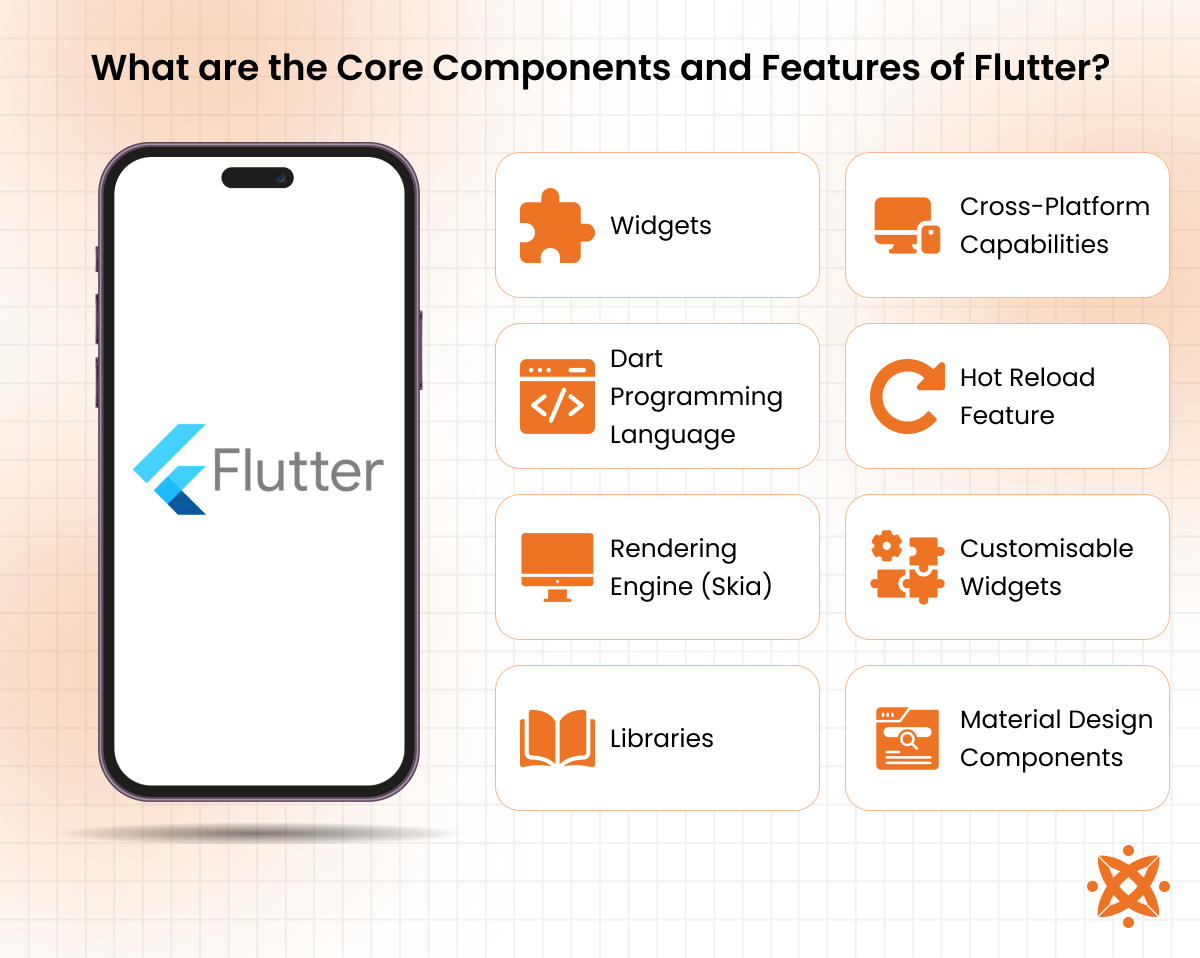
The core components and features of Flutter are as follows:
Flutter enables cross-platform development by allowing developers to write a single codebase followed by compilation to native code for multiple platforms, including iOS, Android, web, and desktop. This is achieved through its high-performance rendering engine, Skia, which renders the UI directly onto the screen, bypassing platform-specific components.
Flutter compiles the Dart code into native ARM or x86 machine code, ensuring optimal performance and a consistent user experience across all supported platforms. This streamlined approach reduces development time and effort while maintaining high-quality results.
The top advantages of Flutter are its native performance, fast development process, and consistent user interface (UI) across platforms. These features make Flutter a popular choice for cross-platform application development.
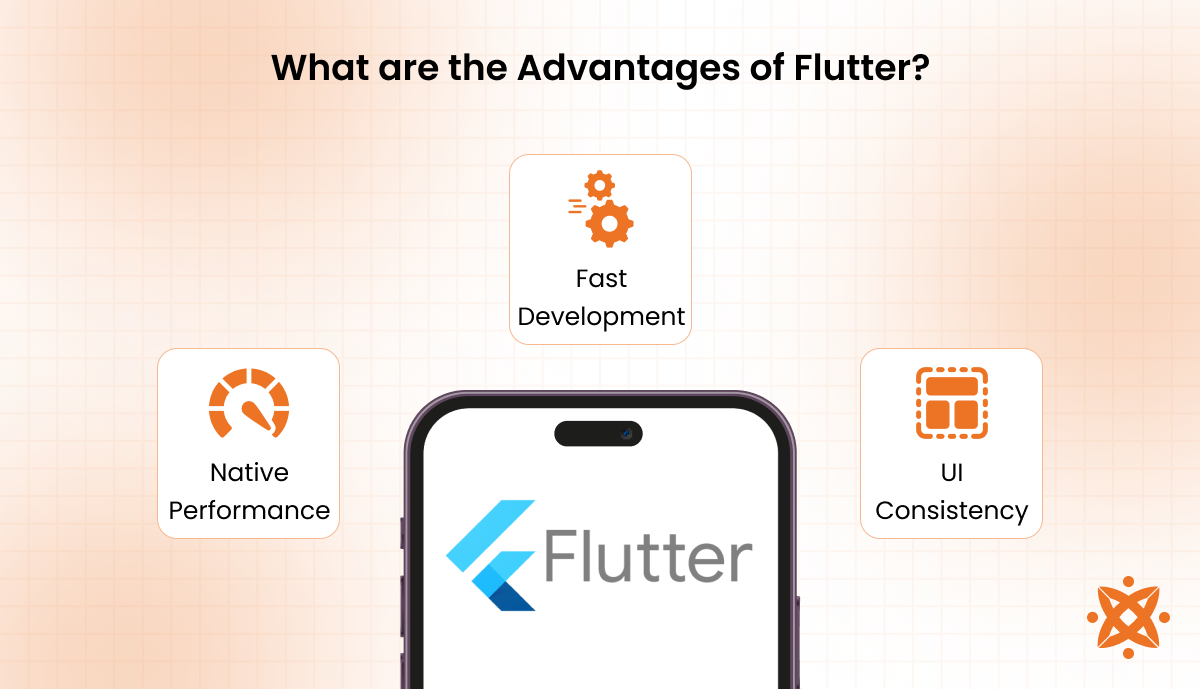
The advantages of Flutter are as follows:
The disadvantages of Flutter are its relatively large app size, limited access to some platform-specific features, and reliance on the Dart programming language, which has a smaller developer community than more established languages like JavaScript.
The disadvantages of Flutter are as follows:
The best state management solutions for Flutter are Provider, Riverpod, and Bloc. These solutions cater to various development scenarios, offering flexibility, performance, and scalability for managing application states effectively.
The best state management solutions for Flutter are as follows:
Flutter app development is the process of creating cross-platform applications using the Flutter framework. It involves writing a single codebase in the Dart programming language, which is then compiled into native code for iOS, Android, web, and desktop platforms.
Flutter app development enables the creation of high-performance, visually appealing apps with a consistent user interface. It uses features like customisable widgets, a fast rendering engine, and the hot reload feature for rapid development and debugging.
The benefits of Flutter apps include reduced development time, native-like performance, and excellent UI consistency across platforms. They are also highly customisable, allowing developers to create unique designs that align with specific branding requirements while maintaining excellent performance and responsiveness.
The popular apps built with Flutter are Google Ads, Alibaba, BMW, Reflectly, and eBay. These apps showcase Flutter's versatility and ability to create high-performance, visually appealing applications for diverse use cases.
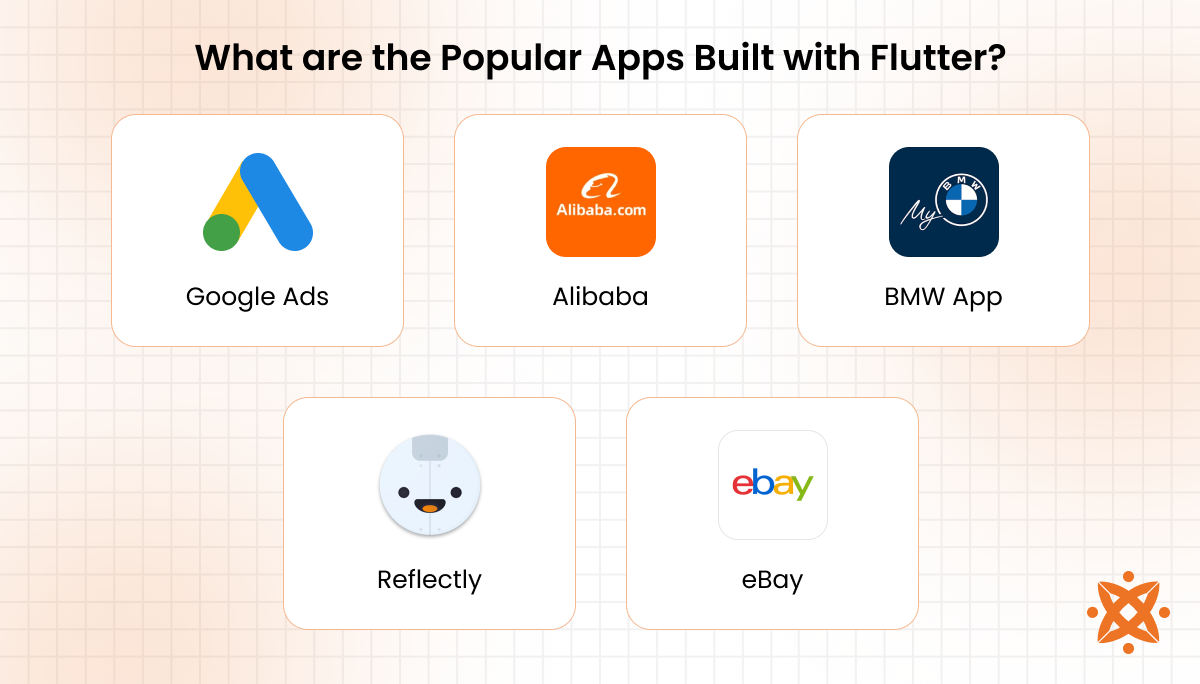
The popular apps built with Flutter are as follows:
Flutter supports mobile app development by providing a unified framework for building high-performance, cross-platform applications using a single codebase. With Flutter, developers create mobile apps for both iOS and Android platforms, ensuring consistent UI and performance across devices.
The development process in Flutter starts with writing the app's code in Dart, Flutter's programming language. Developers then use Flutter's rich set of pre-built widgets to design the user interface and handle business logic. Flutter's hot reload feature allows for rapid testing and iteration, making it easy to see real-time changes without restarting the app.
Flutter's rendering engine, Skia, ensures the app's UI is drawn directly on the screen, providing native-like performance. Flutter guarantees fast execution and smooth animations by compiling the code to native ARM or x86 machine code. This integrated process significantly reduces development time and effort, allowing developers to create visually appealing and high-performing mobile applications.
The best Flutter alternatives for cross-platform development are React Native, Xamarin, and Ionic. These frameworks provide robust tools for building cross-platform apps, each with its own strengths depending on the project's requirements.
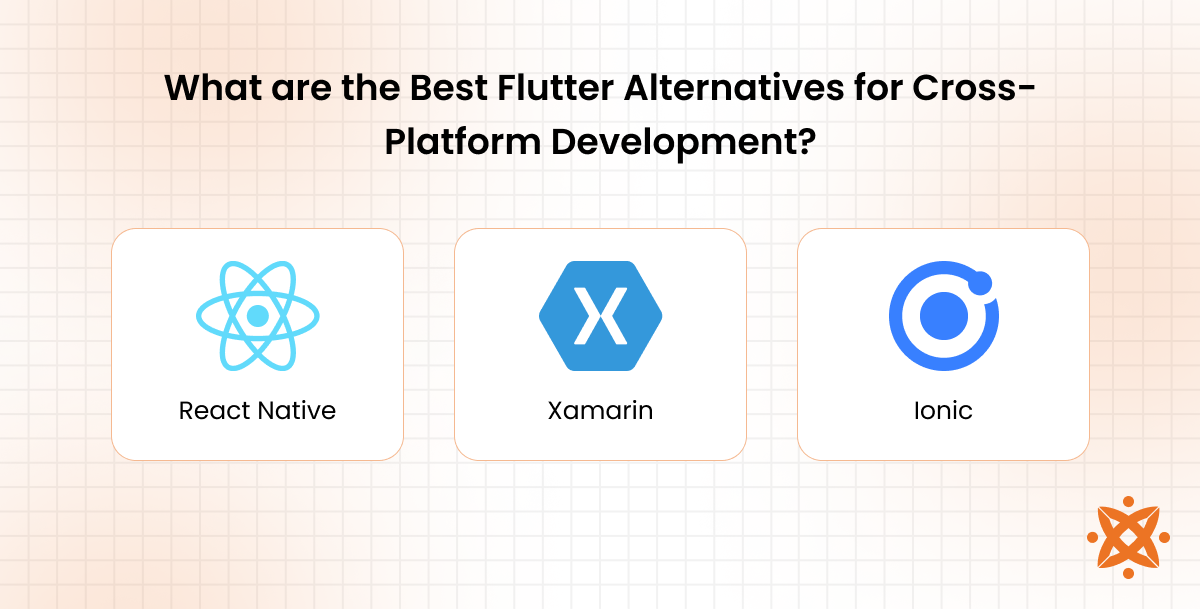
The best Flutter alternatives for cross-platform development are as follows:
The main difference between Flutter and React Native is that Flutter uses the Dart programming language and compiles code to native ARM or x86 machine code, while React Native uses JavaScript and bridges native APIs through JavaScript.
Flutter provides a more consistent performance across platforms due to its rendering engine, which draws UI elements directly, while React Native relies on native components. React Native benefits from a large community and ecosystem built around JavaScript. At the same time, Flutter offers a more uniform approach to UI development with its extensive widget library and higher customisation flexibility.
The main difference between Flutter and Kotlin Multiplatform is that Flutter is a complete SDK that includes a rendering engine and framework for building UIs, while Kotlin Multiplatform focuses primarily on sharing business logic across platforms, leaving UI development to be handled by native components.
Flutter provides a unified development experience with a single codebase for both UI and logic, whereas Kotlin Multiplatform enables developers to write platform-specific UIs, making it more flexible but requiring additional platform-specific work. Kotlin Multiplatform is ideal for teams already using Kotlin, while Flutter is a more comprehensive solution for cross-platform app development.
The main difference between Flutter and ASP.NET Core is that Flutter is a UI framework for building cross-platform mobile, web, and desktop applications, while ASP.NET Core is a server-side web framework for building web applications and APIs.
Flutter focuses on client-side development, providing tools for app design, animations, and smooth UI performance, whereas ASP.NET Core is used for backend development, handling server logic, routing, and database interactions.
Flutter and ASP.NET Core serve different purposes in the application development stack, with Flutter being geared toward front-end development and ASP.NET Core being focused on the back end.
The main difference between Flutter and Qt is that Flutter is primarily focused on building mobile and web applications with a single codebase using Dart, while Qt is a C++-based framework designed for building cross-platform desktops and embedded applications.
Qt offers extensive support for native desktop applications and provides tools for designing applications with complex UIs, while Flutter emphasises a modern, expressive UI with a focus on mobile-first development.
Qt supports a broader range of platforms, including embedded systems, whereas Flutter targets mobile, web, and desktop platforms in a more smooth and modern way.
The main difference between Flutter and NativeScript is that Flutter uses a single codebase to build apps using Dart and its own rendering engine, whereas NativeScript allows developers to write apps using JavaScript, TypeScript, or Angular while accessing native APIs directly.
NativeScript provides full access to native APIs, allowing developers to use platform-specific features more easily. In contrast, Flutter provides a more unified, widget-based approach to building UIs that work across both iOS and Android.
NativeScript is preferred when direct access to native device features is important, while Flutter excels in creating visually rich and consistent user interfaces.
The main difference between Flutter and Apache Cordova is that Flutter compiles to native code and uses a high-performance rendering engine, whereas Apache Cordova is a web-based framework that wraps HTML, CSS, and JavaScript into a native container.
Cordova relies on web views to render the UI, which affects performance, particularly for complex applications, while Flutter ensures better performance and smoother animations by compiling directly to native code.
While Cordova is ideal for web developers transitioning to mobile apps, Flutter offers more flexibility and native-like experiences with its customised widgets and rendering approach.
Yes, Flutter is free. It is an open-source framework developed by Google, and developers access and use it without any cost. The Flutter SDK, which includes all the tools necessary for building applications, is available for download on GitHub, and it is licensed under the BSD 3-Clause License. This means developers modify and distribute it freely, making it highly accessible for individuals and companies looking to build cross-platform apps.
A Flutter developer is a software developer who specialises in using the Flutter framework to build cross-platform mobile, web, and desktop applications. They write code using the Dart programming language and use Flutter's widget-based architecture to design user interfaces, manage state, and integrate with APIs.
Flutter developers are skilled in creating high-performance, visually appealing apps that work smoothly across platforms, utilising features like hot reload and the Flutter rendering engine to facilitate the development process.
Sign up now and get notified when we publish a new article!
Co-Founder
Hey there. I am Dhaval Sarvaiya, one of the Founders of Intelivita. Intelivita is a mobile app development company that helps companies achieve the goal of Digital Transformation. I help Enterprises and Startups overcome their Digital Transformation and mobile app development challenges with the might of on-demand solutions powered by cutting-edge technology.
