


Co-Founder

Web development encompasses creating and maintaining websites and web applications, ensuring efficient functionality, user-friendly interfaces, and engaging experiences. Web development involves a combination of coding, design, and content management to build platforms accessible via the internet.
In the UK, the web development sector has experienced fluctuations in recent years. According to a survey by the Expert Market, about 71% of all businesses had websites in 2021, and 98% of small businesses had them in 2023. As of December 2024, job postings in tech sectors, including software development, were more than 40% below 2019 levels, indicating a significant decline in hiring within the industry.
Web development is categorised into three primary types: front-end, back-end, and full stack. Frontend development focuses on the visual and interactive aspects that users engage with directly. Back-end development manages server-side operations, databases, and application logic. Full stack development combines both front-end and back-end expertise, enabling you to handle all facets of web development.
Building a website involves planning the site's structure and goals, designing the user interface with attention to responsive web design, developing the front-end and backend components, integrating APIs for enhanced functionality, and conducting thorough testing to ensure web security best practices and optimal performance. Following web development best practices throughout this process ensures a robust and user-friendly website.
When selecting a web development company, you must consider factors such as its portfolio of past projects, expertise in relevant technologies, understanding of user experience design, adherence to web security best practices, and knowledge of search engine optimisation. Evaluating these aspects, you ensure the chosen partner delivers a website that aligns with your business objectives and provides users with a secure, engaging experience.
Web development is the process of creating and maintaining websites and web applications that are accessible through the Internet or a private network. It encompasses various tasks, including coding, designing, and configuring server-side and client-side functionalities to ensure efficient performance.
Web development is the backbone that brings digital experiences to life, whether you are building a simple static webpage or a complex, dynamic platform. It involves multiple programming languages, frameworks, and technologies that evolve continuously to meet modern demands.
Web development is important as it is paramount in how businesses, organisations, and individuals establish their digital presence. A well-developed website enhances user engagement, provides a platform for communication, and facilitates e-commerce, online services, and information sharing. According to Siteefy, there are almost 1.2 billion websites worldwide as of January 2025. Of those websites, just under 195 million are currently active.
From corporate websites and social media platforms to web applications supporting banking, healthcare, and education, web development shapes how you interact with the digital world. Its ability to facilitate digital operations, improve accessibility, and drive innovation makes it indispensable across industries.
The history of web development dates back to the early 1990s when Tim Berners-Lee introduced the first website, marking the beginning of the World Wide Web. Initially, websites were simple, consisting of static HTML pages with basic text and hyperlinks. As the internet evolved, the introduction of CSS and JavaScript enabled more interactive and visually appealing web designs.
The late 1990s and early 2000s saw the rise of server-side technologies like PHP and databases, paving the way for dynamic content generation. Over the years, advancements such as responsive design, cloud computing, and AI-driven applications have transformed web development, making it more sophisticated and user-centric.
A website is your digital space online, where you present information, provide services, or engage with users. Whether it's a platform to showcase your brand, an online store selling products, or a news portal delivering updates, a website acts as a bridge between you and your audience.
The internet hosts various websites, from e-commerce giants like Amazon to educational platforms like Coursera, social networks like Facebook, and service-based sites like Airbnb. Each website serves a unique purpose but shares the goal of delivering content and functionality to users.
There are several key features that define an effective website. User-friendly navigation ensures that as a visitor, you easily find what you need without confusion. A responsive design allows effortless access across devices, whether on desktops, tablets, or smartphones.
Speed and performance are another important website feature, as slow-loading pages drive users away. Security features like SSL encryption protect user data, especially for e-commerce and financial transactions. Engaging content and intuitive design enhance the user experience, keeping visitors interested and encouraging return visits.
For small businesses, a website offers immense advantages. It provides a cost-effective way to reach a broader audience beyond physical locations, helping attract new customers. A well-optimised site increases visibility on search engines, making it easier for potential clients to find you.
Websites also establish credibility, giving businesses a professional presence that builds trust. Moreover, online stores allow small businesses to operate 24/7, boosting sales and customer engagement. Having a website is not just an option but a necessity for growth and success in the modern era.
The different types of web development are front-end, back-end, and full-stack development, each playing a distinct role in building functional and engaging web experiences. Frontend development focuses on the user interface and design, ensuring an effortless and interactive experience. Back-end development powers the server-side operations, handling data management, security, and performance. Full stack development combines both front-end and back-end expertise, allowing you to build complete web applications from start to finish.
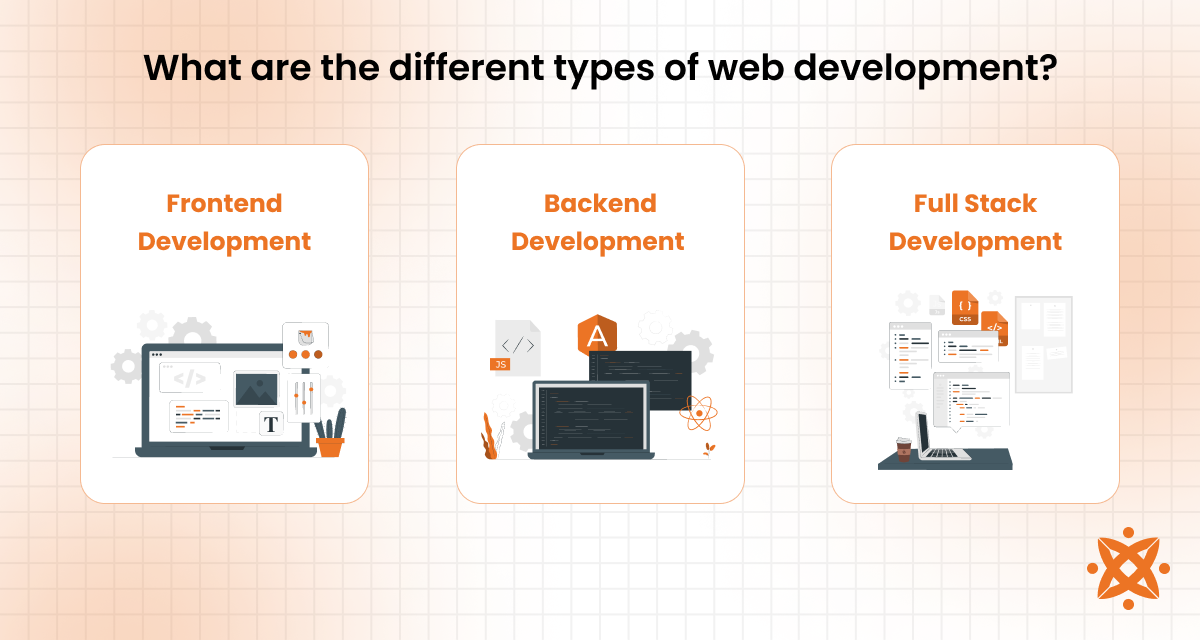
The different types of web development are as follows:
Frontend development shapes what you see and interact with on a website, ensuring a visually appealing and responsive design. It involves structuring content, styling elements, and implementing interactive features to enhance user engagement. Technologies like HTML and CSS form the foundation, while JavaScript frameworks such as React, Angular, and Vue.js help create dynamic and efficient interfaces. These tools enable smooth navigation, animations, and real-time updates, making web pages more interactive and engaging.
Back-end development handles the behind-the-scenes functionality that powers websites and applications. It manages databases, processes requests, and ensures secure data transmission between the server and the user interface. Key backend technologies include databases like MySQL, PostgreSQL, and MongoDB, which store and organise data efficiently. Frameworks like Node.js, Django, and Ruby on Rails simplify backend development, while programming languages like Python, Java, PHP, and C# provide the logic and computational power needed to execute complex processes. These elements work together to deliver efficient performance and data security.
Full stack development combines front-end and back-end expertise, allowing you to build fully functional web applications. It requires knowledge of user interface design, server-side logic, database management, and API integrations. Full-stack developers work with technologies like the MERN (MongoDB, Express.js, React, Node.js) or MEAN (MongoDB, Express.js, Angular, Node.js) stacks, which simplify development. They also use multiple programming languages, including JavaScript, Python, and Java, along with frameworks like Express.js, Django, and Spring Boot. Full-stack developers efficiently manage and optimise entire projects by mastering both sides of web development.
The common databases and APIs in web development are MySQL, PostgreSQL, MongoDB, MariaDB, and SQLite for data storage, along with RESTful APIs and GraphQL for communication between systems. You can store, manage, and retrieve data efficiently using databases, while APIs enable you to interact between different applications and services efficiently. Databases and APIs work together to support dynamic websites, web applications, and cloud-based platforms.
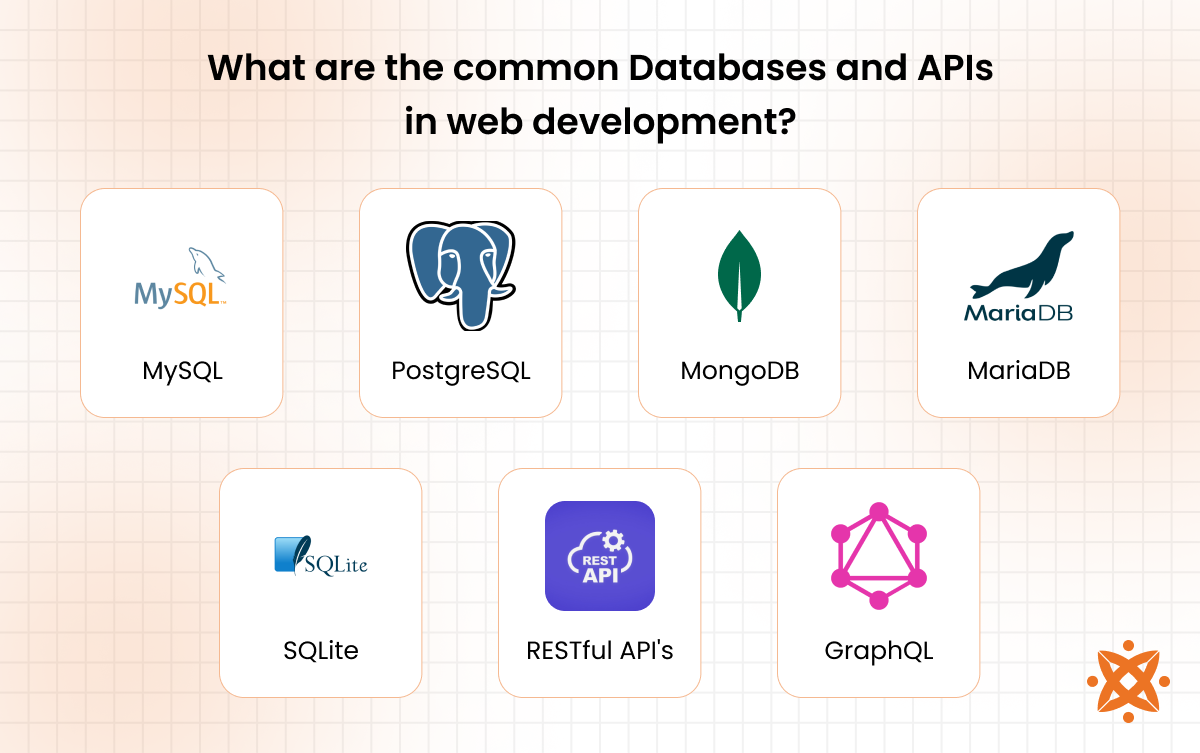
The common databases and APIs in web development are as follows:
The common tools used in web development are code editors, version control systems, package managers, front-end frameworks, back-end frameworks, and browser developer tools. These tools facilitate the web development process, improve efficiency, and ensure code quality by providing fundamental functionalities such as debugging, collaboration, and automation. According to a study by Siteefy, 252,000 new websites are created daily. Relying on these tools helps you build, test, and maintain web applications with greater precision and speed.
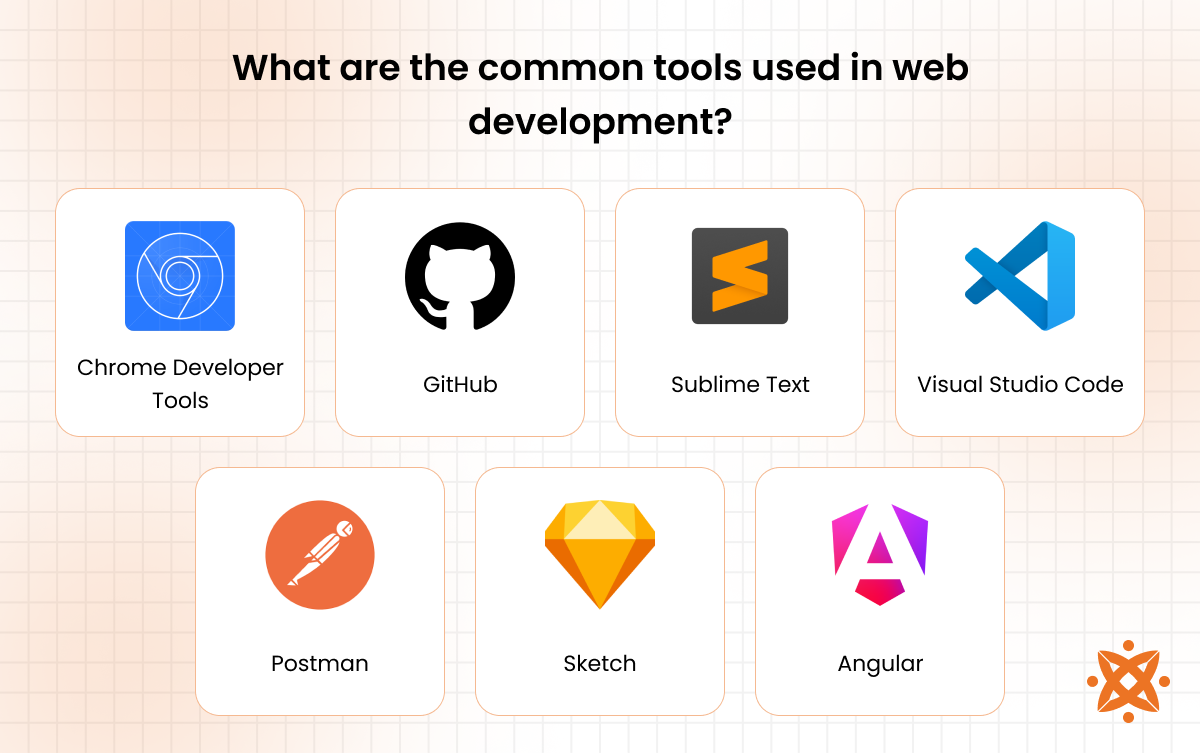
The common tools used in web development are as follows:
To design and develop a website, you follow a structured process that includes planning, designing, coding, testing, and launching. This ensures the final product is visually appealing, functional, and optimised for performance. A well-designed website enhances user experience, meets business goals, and adapts to digital trends.
To design and develop a website, you follow the following steps:
Before developing, you define the website's purpose, target audience, and key functionalities. This includes conducting market research, analysing competitors, and outlining a content strategy. Creating wireframes and site maps helps visualise the website's structure and flow, ensuring a smooth user experience before moving to the design phase.
The design phase focuses on creating an intuitive and visually engaging layout. You choose color schemes, typography, and branding elements that align with the website's identity. Tools like Adobe XD, Figma, and Sketch help create interactive prototypes that showcase how the final website looks and functions. A responsive design approach ensures the website adapts to different screen sizes and devices.
Once the design is finalised, you use front-end technologies like HTML, CSS, and JavaScript to bring it to life, while backend frameworks manage server-side logic and databases. Content is added, and interactive elements are implemented. Testing is conducted to identify bugs, optimise performance, and ensure compatibility across browsers and devices. After final revisions, the website is deployed and continuously monitored for improvements.
Yes, you can develop a website with AI like ChatGPT, but it depends on the level of complexity required. AI tools assist you with code generation, design suggestions, and automation of repetitive tasks, making the development process faster and more efficient. AI is not yet capable of independently building fully customised, high-quality websites without human input. Developers still play an integral role in structuring content, optimising performance, and ensuring a flawless user experience.
The main difference between web development and web design is that web development focuses on building and maintaining the functional aspects of a website, while web design is concerned with the visual and user experience elements. Web developers use programming languages, frameworks, and databases to create a website's backend and frontend functionalities. On the other hand, web designers work with layout, color schemes, typography, and branding to create an engaging and user-friendly interface. While both disciplines are necessary for a successful web design, they require different skill sets and tools.
The main difference between web development and app development is that web development focuses on building websites and web applications that run in a browser, whereas app development involves creating mobile or desktop applications that run natively on specific operating systems. Web development relies on technologies like HTML, CSS, JavaScript, and backend frameworks. In contrast, app development requires platform-specific languages such as Swift for iOS, Kotlin for Android or cross-platform tools like React Native. Web applications are accessed via the internet, while native apps require installation on a device.
To build a web app, you must define its purpose, design the user interface, develop the front and back end, and deploy it for users. The process begins with planning the app's functionality and user flow and designing wireframes and prototypes. Developers then build the application using front-end technologies like React or Vue.js and backend frameworks like Node.js or Django. Database integration ensures data management, and thorough testing is conducted before deployment. The web app is hosted on a server and optimised for performance, security, and scalability.
To choose a web development company, you must evaluate their expertise, portfolio, and ability to meet your project requirements. A reliable company has a proven track record of delivering high-quality web solutions, aligning with your business goals, and offering ongoing support. Selecting the right agency ensures your website is functional, scalable, and optimised for success.
To choose a web development company, you look for the below-mentioned features:
Choosing the right agency is important for building a successful online presence. If you are looking for a professional web development company, consider Intelivita. With a team of experienced developers, Intelivita delivers custom solutions customised to business needs. They prioritise user experience, security, and scalability, ensuring your website is both high-performing and future-proof.
It costs an average of £3,000 to £15,000 to develop a website in the UK, depending on various factors. The overall cost of website development is influenced by the website's complexity, desired features, design requirements, and the development team's expertise. For instance, a basic informational website with minimal features is on the lower end of the spectrum, while a complex e-commerce platform with custom functionalities incurs higher expenses. Ongoing maintenance, domain registration, and hosting services contribute to the total website development cost.
The best practices for website development are ensuring responsive design, optimising performance, implementing strong security measures, and focusing on user experience. These practices help you create websites that are fast, secure, and accessible across all devices, improving engagement and search rankings.
The best practices for website development are as follows:
The common web development mistakes to avoid are neglecting mobile responsiveness, slow loading speeds, poor security, lack of SEO optimisation, and bad UI/UX design. These mistakes negatively impact user experience, search engine rankings, and overall business success. Avoiding these common web development mistakes ensures a smoother, more effective website.
The common web development mistakes are as follows:
The new trends in website development are AI-driven automation, Progressive Web Apps (PWAs), voice search optimisation, serverless architecture, and enhanced cybersecurity. These trends shape the future of web development, making websites more intelligent, efficient, and secure.
The trends in website development are as follows:
Sign up now and get notified when we publish a new article!
Co-Founder
Oliver Baker is a co-founder of Intelivita, a leading Web and Mobile App Development Company based in Leeds, UK. Oliver has been at the forefront of the business, expanding it globally and into new technologies including iOS and Android, AR, VR and Mobile Game applications. Oliver excels in Project Management, Leadership, Quality Assurance and Problem Solving and has qualifications with Prince2 and APM. He aims to develop his skills further through a shared interest with other leaders in the Software Markets and the Clients of Intelivita.
