


Co-Founder

The Uber taxi app refers to a mobile app platform designed to connect riders and drivers easily through ride-matching algorithms, real-time GPS tracking, and in-app payments. Its function allows users to book rides, estimate fares, and schedule trips while ensuring safety through features like emergency buttons and driver ratings.
According to a report by Statista titled "Monthly users of Uber's ride-sharing app worldwide 2017-2023," published in April 2024, 150 million people used the Uber app at least once per month in the fourth quarter of 2023.
The Uber taxi app’s key features include location tracking, fare estimation, ride scheduling, and ride-sharing options like Uber Pool. The Uber taxi software supports payment integration, detailed driver and rider profiles, and a two-way rating system to ensure accountability and enhance the user experience.
The Uber app is compatible with Android, iOS, and web platforms and offers a responsive design for enhanced device adaptability. This ensures users access the app on a wide range of devices while maintaining consistent functionality.
Developing a taxi app like Uber involves visualization, followed by design and prototyping to outline the user interface. The process continues with backend and frontend development, including ride-matching algorithms, API integration, and features like real-time GPS tracking, culminating in testing and deployment.
The cost of developing a taxi app like Uber ranges from £15,000 to £45,000, depending on the app’s complexity and features, such as payment integration, location tracking, and ride scheduling.
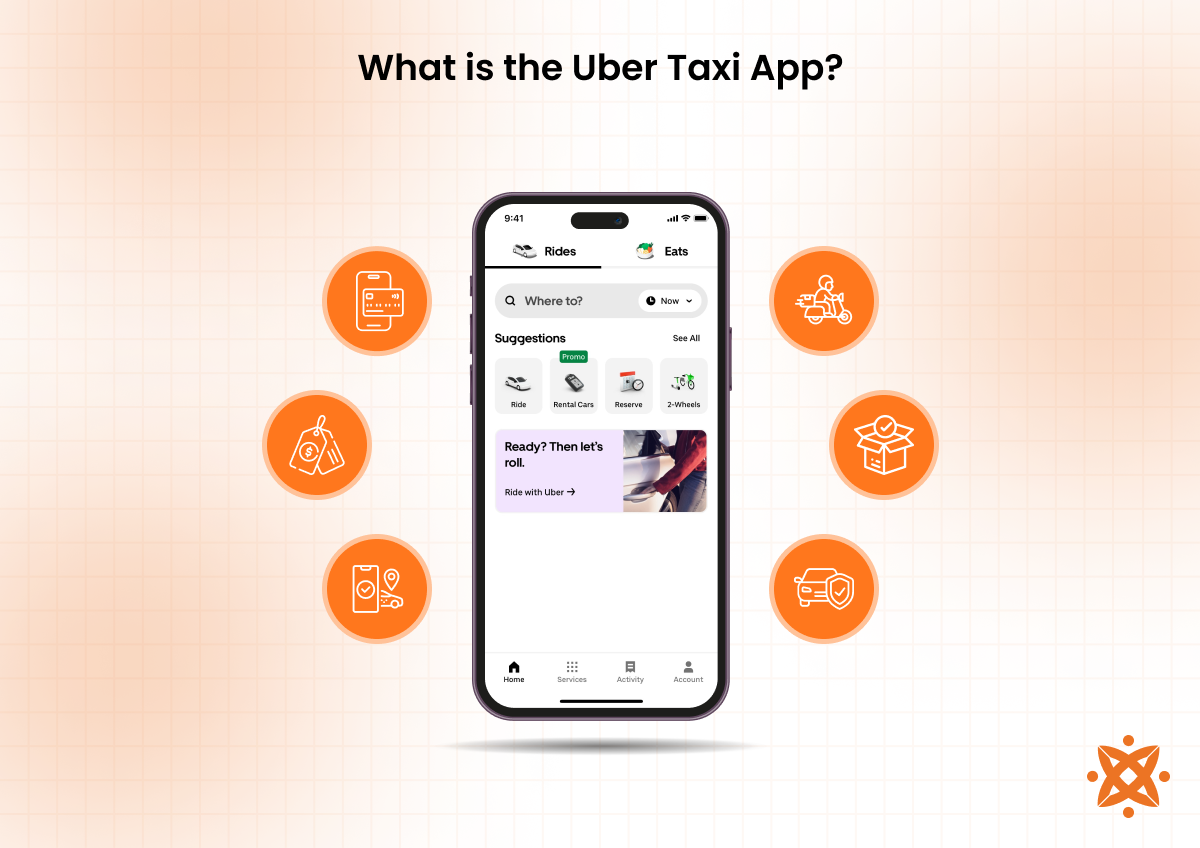
The Uber taxi app is a technological platform that links riders with drivers through a mobile phone application, resulting in on-demand transportation services. The cab booking app’s primary function is flawless interactions between the user and service providers. The transport application makes urban mobility easily accessible and efficient.
The Uber taxi app looks like a map with the user’s current location and nearby available drivers displayed. The app is user-friendly and has areas where the user can input their destinations, see estimated fares, and choose from different ride options. The app offers real-time tracking of the driver’s route and arrival time. The Uber taxi app’s simple design and layout increase user engagement and enhance satisfaction.
The Uber app provides services such as ride-hailing, food delivery, freight transportation, and package delivery options. These diverse services have expanded the Uber app’s appeal far beyond transportation, making it a well-rounded logistics platform.
The Uber taxi app functions as a ride-hailing platform by allowing users to request rides. The request matches nearby drivers who choose to go on the journey or not. The taxi app gives both drivers and riders information, ensuring reliability and trust between users and service providers.
The difference between Uber's taxi app and traditional taxi services is features like upfront pricing, scheduled rides, and budget and need accommodation. Uber's real-time tracking and cashless payment system increase convenience and transparency, reducing the use of conventional taxi services.
According to data published in Demand Analysis Report (2024), as of Q2 2024, Uber had 156 million monthly active users, reflecting a 14% year-over-year increase. In the same quarter, Uber drivers completed 2.8 billion trips, marking a 21% growth compared to the previous year. These figures show the growing popularity of this taxi-hailing application.
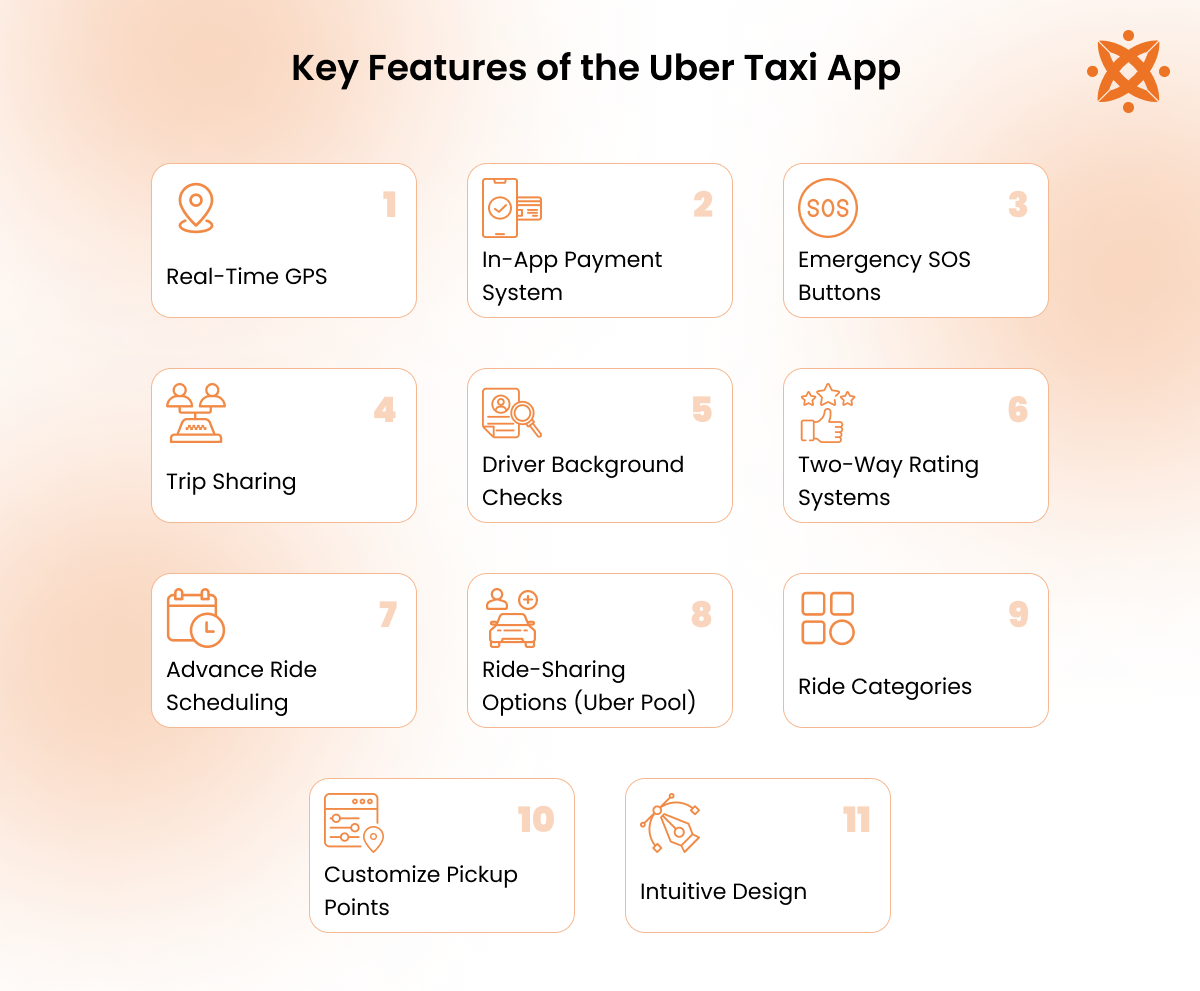
The key features of the Uber taxi app are real-time GPS, an in-app payment system, emergency SOS buttons, trip sharing, driver background checks, a two-way rating system, advanced ride scheduling, ride-sharing options (Uber Pool), various ride categories, ability to customize pickup points, an intuitive design, multi-language options, and a customer service chat to ensure convenience, safety, and accessibility for users.
The key features of the Uber taxi app include:
Each of these features enhances the Uber taxi app experience. They focus on efficiency, safety, and convenience while accommodating the diverse needs of their users worldwide.
The Uber taxi app is compatible with iOS and Android operating systems, which ensure broad accessibility across various devices. iOS is an Apple-proprietary mobile operating system seen on devices like the iPhone and iPad. iPhone and iPad users using a minimum iOS version of 15.0 can download the Uber app from the Apple App Store.
Android is a Google-owned open-source operating system that powers many devices from various manufacturers. The Uber taxi app is available on the Google Play Store for Android versions 8.0 and higher.
This compatibility ensures that the taxi-hailing app functions smoothly on a range of devices, including those with diverse hardware configurations.
Uber taxi app also has a web-based platform that caters to users with low-end devices or unsupported operating systems. This cross-platform solution enables users to access Uber's services through a mobile or desktop browser, ensuring functionality without requiring app installation.
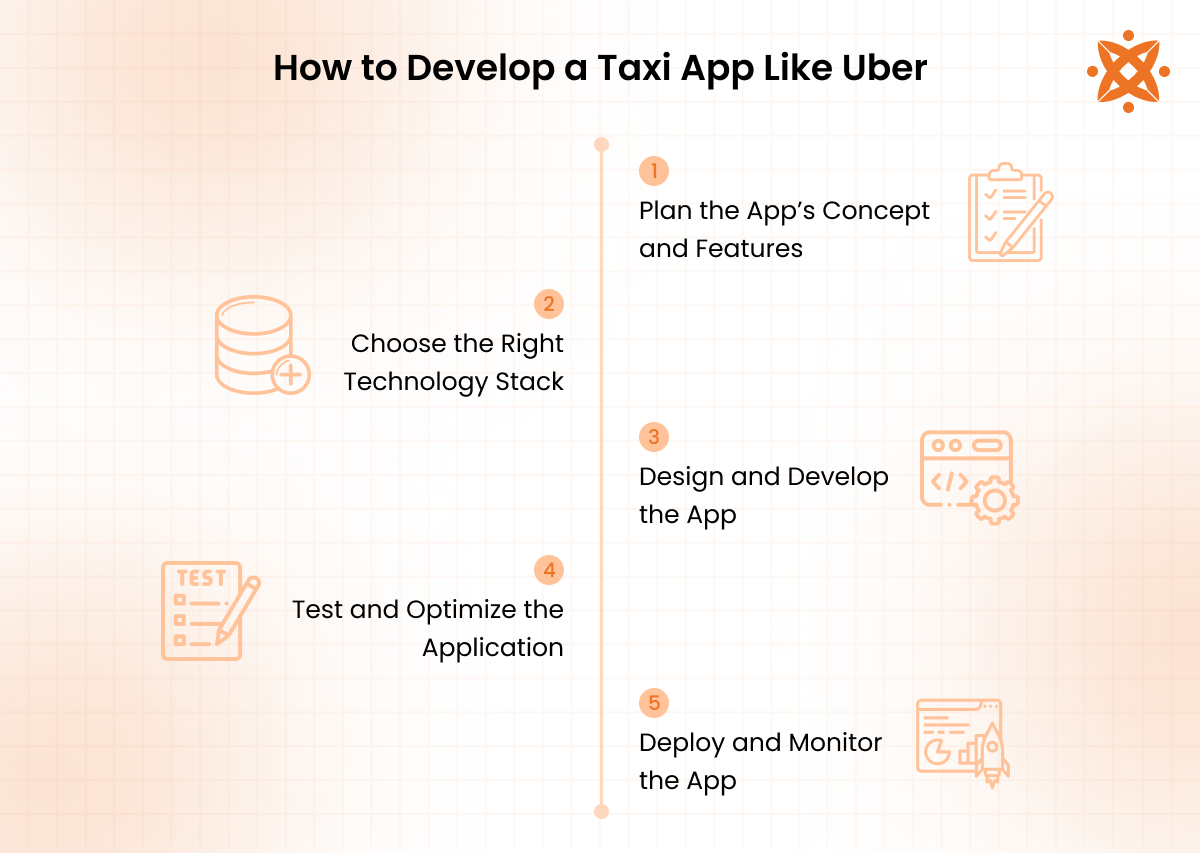
To develop a taxi app like Uber, the steps include:
The first step in developing a taxi app like Uber involves defining its concept and identifying the core features that will effectively address user needs. This step requires heavy market research and competitor analysis to understand the target audience's preferences.
The critical features of this app are real-time GPS tracking and ride matching. Other features are fare estimation, ride scheduling, user safety features, multi-language support, and payment integration. This planning process includes workflow drafts and app interface visualization to ensure functionality.
A reliable taxi app relies on its technology stack, which includes the appropriate tools and technologies to ensure scalability, performance, and maintenance. Kotlin is the recommended programming language for Android development, while Swift is best for iOS. Both languages provide optimized performance on their respective platforms.
However, for backend development, Node.js offers event-driven architecture suitable for real-time data handling, while Django delivers a robust framework for Python-based applications.
Databases such as MongoDB or PostgreSQL support efficient data management and accommodate high volumes of user and ride data. Key integrations, like payment gateways for secure transactions and mapping services such as the Google Maps API, are also vital for location-based services.
This step lays the groundwork for an app that is both reliable and user-friendly.
The design and development stage focuses on creating an intuitive user interface (UI) that delivers an excellent user experience (UX). Prototypes are developed to visualize the app’s flow and refine its functionality before coding begins.
The development phase incorporates relevant features such as ride matching, real-time GPS tracking, ride scheduling, and user safety features. It ensures the app provides a smooth experience for both riders and drivers.
Push notifications are also integrated to keep users updated on ride statuses and other relevant information. This phase ensures that the app is functional, visually appealing, and responsive.
Rigorous testing is necessary for the app to meet user expectations and perform well under varying conditions. Quality assurance testing identifies and resolves bugs, ensuring features like payment integration and ride matching work flawlessly. Security testing focuses on safeguarding sensitive user data, including payment information.
A taxi app like Uber should also be tested for low latency and scalability, ensuring it can handle high user traffic without performance issues. Cross-platform compatibility is evaluated to provide a consistent experience, ensuring the app functions equally well on Android and iOS devices.
Testing tools and real-device platforms help simulate various use cases, allowing developers to optimize the app for maximum efficiency.
The final step in developing a taxi app like Uber involves deploying the app on the Apple App Store and Google Play Store. The app must comply with platform-specific guidelines.
Post-deployment monitoring tools track the app’s performance, collecting data on user behavior and identifying areas for improvement. Regular updates are rolled out to address bugs, introduce new features, and maintain compatibility with the latest operating system versions.
Continuous monitoring ensures the app remains responsive to user needs while maintaining real-time GPS tracking, payment integration, and other essential features. This phase solidifies the app's presence in the market and ensures long-term success.
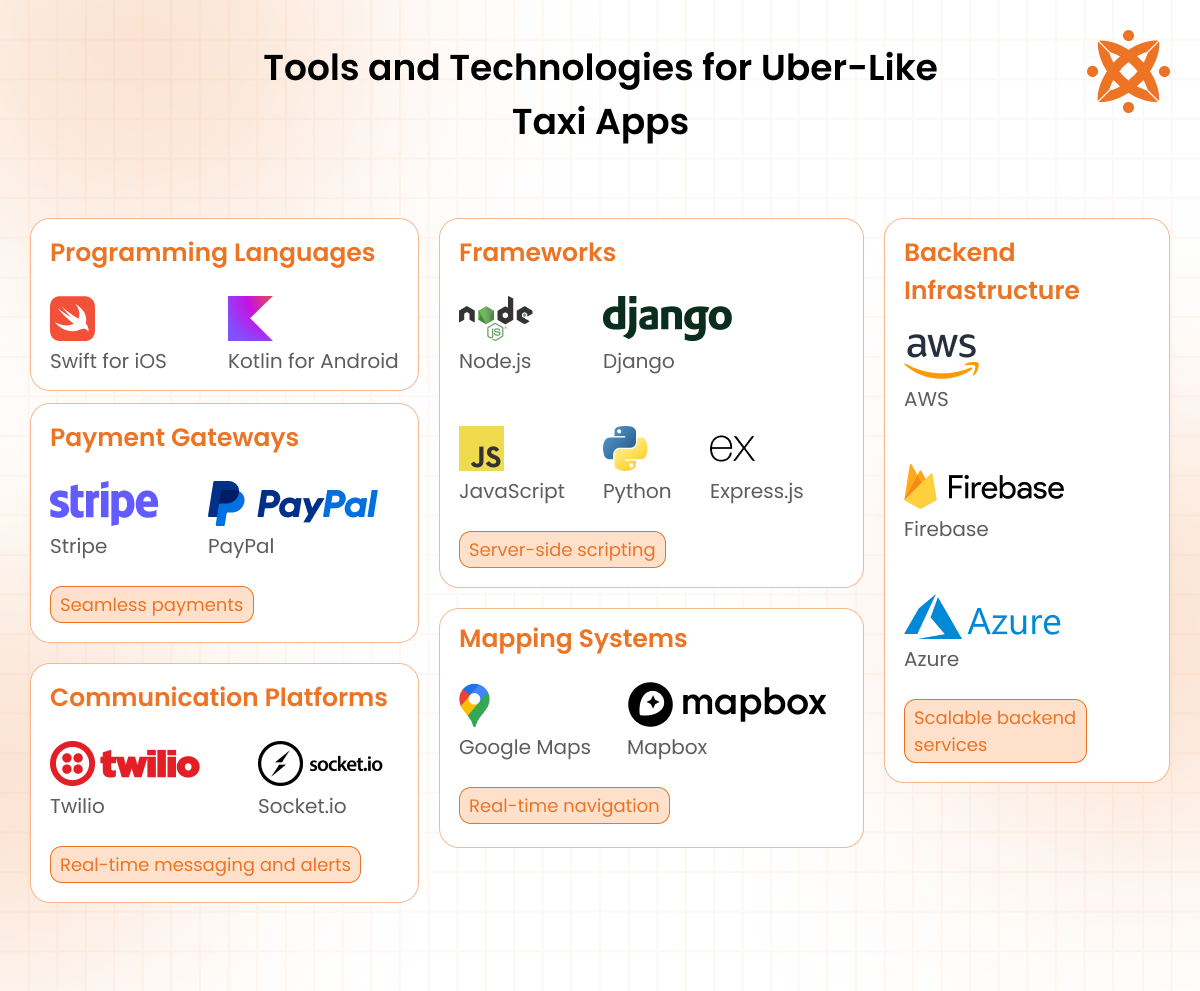
The tools and technologies used in Uber-like taxi app development include programming languages, mapping systems, payment gateways, communication platforms, and backend infrastructure tools and software.
These tools are categorized based on their specific roles in the app’s development and functionality.
Programming languages and frameworks are the backbone of app development. They enable the integration of core functionalities like ride scheduling, real-time GPS tracking, and user interfaces. These tools streamline coding and ensure the app's performance across various platforms.
Mapping and navigation tools enable key features like fare estimation, customized pickup points, and route optimization. They ensure riders and drivers have accurate and real-time data for a smooth ride experience.
Secure and efficient payment processing is central to a taxi app’s success. These tools ensure reliable payment integration and protect sensitive financial data.
Real-time communication and notifications improve app functionality by keeping users informed and connected. These tools power features like push notifications, status updates, and chat options.
A robust backend infrastructure ensures the app is scalable, secure, and capable of handling large volumes of data efficiently. Databases store and manage app data, enabling features like ride scheduling and user profiles.
Leveraging these tools and technologies helps developers create an Uber-like taxi app that delivers exceptional user experience (UX). It integrates essential features like mapping services, ride matching, and multi-language support while ensuring scalability and security.
The cost of developing a taxi app like Uber ranges from £15,000 to £45,000, depending on various factors such as app complexity, targeted platforms, and the development team's geographical location.
These costs are influenced by the integration of features like real-time tracking, ride-matching algorithms, and payment gateways, as well as the time and resources required for development.
App complexity and the number of features also significantly impact the total cost. A basic app with features like real-time GPS tracking, fare estimation, and notification systems costs around £8000 - £12,000.
However, adding advanced functionalities such as multi-language support, detailed UI/UX design, and ride scheduling increases expenses to £30,000 or more. Integrating tools like Google Maps for navigation or Twilio for communication adds £5000 to £10,000, depending on the level of customization required.
Targeted platforms also affect costs. A single-platform app costs around £8,000 to £12,000, while a cross-platform app ranges from £15,000 to £50,000 due to additional compatibility requirements.
In North America, developers charge $100 to $150 per hour. In Western Europe (UK), hourly rates range from £50 to £150. Eastern Europe offers more affordable rates at $30 to $70 per hour, while developers in Asia charge between $20 and $50 per hour.
A basic app with essential features like GPS tracking and notifications typically takes 2 to 4 months to develop and costs between £8,000 and £12,000. A moderate app with additional functionalities such as ride scheduling and multi-language support requires 4 to 6 months, costing between £15,000 and £30,000. For a complex app with advanced features like ride-matching algorithms, scalability, and low latency, development takes 9 months or more, with costs ranging from £35,000 to £80,000.
Post-launch costs also play a significant role. Regular app maintenance and updates cost between £7,500 and £10,000 annually, while server hosting and API usage fees range from $1,000 to $5,000 per month, depending on user volume. Establishing a customer support infrastructure and running effective marketing campaigns add approximately $20,000 to $50,000 annually, based on the app's scale and user base.
Yes, you need an Uber app. The app serves as the primary platform for accessing Uber taxi app services, such as booking rides, tracking drivers, and managing payments. The app gives an intuitive user interface (UI) that simplifies ride-hailing services. It also has features like GPS tracking, ride scheduling, and payment integration. These features are accessible only through the app.
Although Uber offers a web-based platform, the app is the most efficient and functional way to interact with Uber taxi services on iOS and Android devices.
Yes, the Uber app is easy to use. It’s built with a simple and clear design, making it accessible for riders of all tech skill levels. The app makes booking rides straightforward by offering real-time GPS tracking, fare estimates, and ride options right on the main screen.
Features like push notifications and a smooth payment process make the experience hassle-free. With its logical layout and helpful prompts, even first-time users can navigate the app with ease, making Uber one of the most user-friendly ride-hailing services.
To use the Uber taxi app, download it from the Apple App Store or Google Play Store and create an account. Then, open the app, enter your destination in the "Where to?" field, and select your preferred ride type based on price and comfort.
The app will display real-time GPS tracking of your driver and an estimated time of arrival. Once the ride is complete, payment is processed automatically through the app’s payment integration. Additional features, like ride scheduling and trip sharing, provide users with more flexibility and security when using the app.
Alternative taxi apps for Uber include Lyft, Bolt, Grab, and Didi Chuxing. They offer similar ride-hailing services with varying features and pricing. Each of these alternatives includes essential features like real-time tracking, payment integration, and user-friendly apps tailored to their specific regions.
To choose a taxi app development agency, you must evaluate their expertise, portfolio, and ability to deliver your project efficiently. Look for agencies with experience in creating feature-rich apps, including real-time GPS tracking, ride-matching algorithms, and payment integration.
Verify that they are proficient in technologies like Swift, Kotlin, and backend frameworks such as Node.js or Django. Ensure the agency handles UI/UX design, API usage, and scalability to support growth.
Lastly, prioritize agencies that offer post-launch support, including app maintenance, updates, and customer service integration. Cost, communication, and client reviews are also necessary factors to consider when making your decision.
Sign up now and get notified when we publish a new article!
Co-Founder
Hey there. I am Dhaval Sarvaiya, one of the Founders of Intelivita. Intelivita is a mobile app development company that helps companies achieve the goal of Digital Transformation. I help Enterprises and Startups overcome their Digital Transformation and mobile app development challenges with the might of on-demand solutions powered by cutting-edge technology.
