


Co-Founder

Python is used in backend web development because it helps you build, structure, and integrate complex server-side systems with less code and greater clarity.
The main primary benefits of using Python for back-end web development include faster development time, high code readability, strong community support, smooth integration, flexible architecture, a wide range of libraries, and dependable scalability.
While Python is used for front-end web development through tools like Brython or Pyodide, it's not browser-native like JavaScript, HTML, or CSS. You face performance limits, reduced compatibility, and weaker ecosystem support on the front-end.
According to the TIOBE Index (2025), Python held a 25.87% share of global developer interest, more than double that of its nearest competitor, C++, at 10.68%.
When hiring a backend web development company, consider their experience with full-stack systems, the frameworks they use, and their ability to write clean, secure, and scalable code.
Intelivita stands out as the best choice for backend web development across the UK, USA, Canada, Australia, and India. Whether you need a dedicated backend developer or a full-stack team, Intelivita delivers customised, production-ready solutions for any industry.
Python is primarily used for backend development for the following reasons: server-sidescriptingefficiency,cleanlogicprocessing,simplified APIbuilding,extensivelibrarysupport,rapidgrowth,scalabilityforhigh-trafficapps,andsmooth integration with databases. These qualities make it dependable for managing backend logic, handling data flow, and serving dynamic web content.
Python is primarily used for backend development because of the following reasons:
Python's strength in back-end development comes from its simplicity, adaptability, and deep ecosystem.
The common Python backend libraries include Flask, Django, FastAPI, SQLAlchemy, Celery, Requests, and Marshmallow. These libraries help you handle everything from HTTP requests to database management, task queues, and data validation in backend systems.
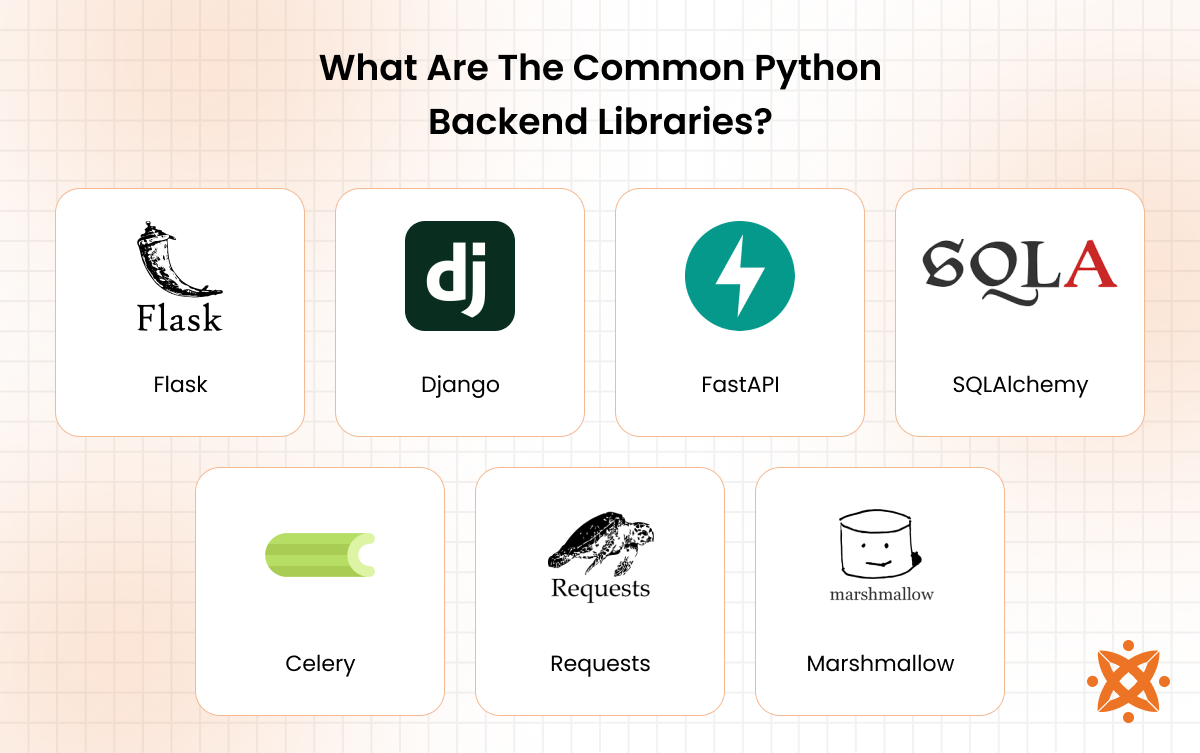
The common Python backend libraries are explained below:
The primary benefits of using Python for back-end web development include faster development time, strong community support, high code readability, easy integration, flexible architecture, broad library availability, and excellent scalability. These features give you practical advantages when managing the logic, data, and communication layers of your web application.
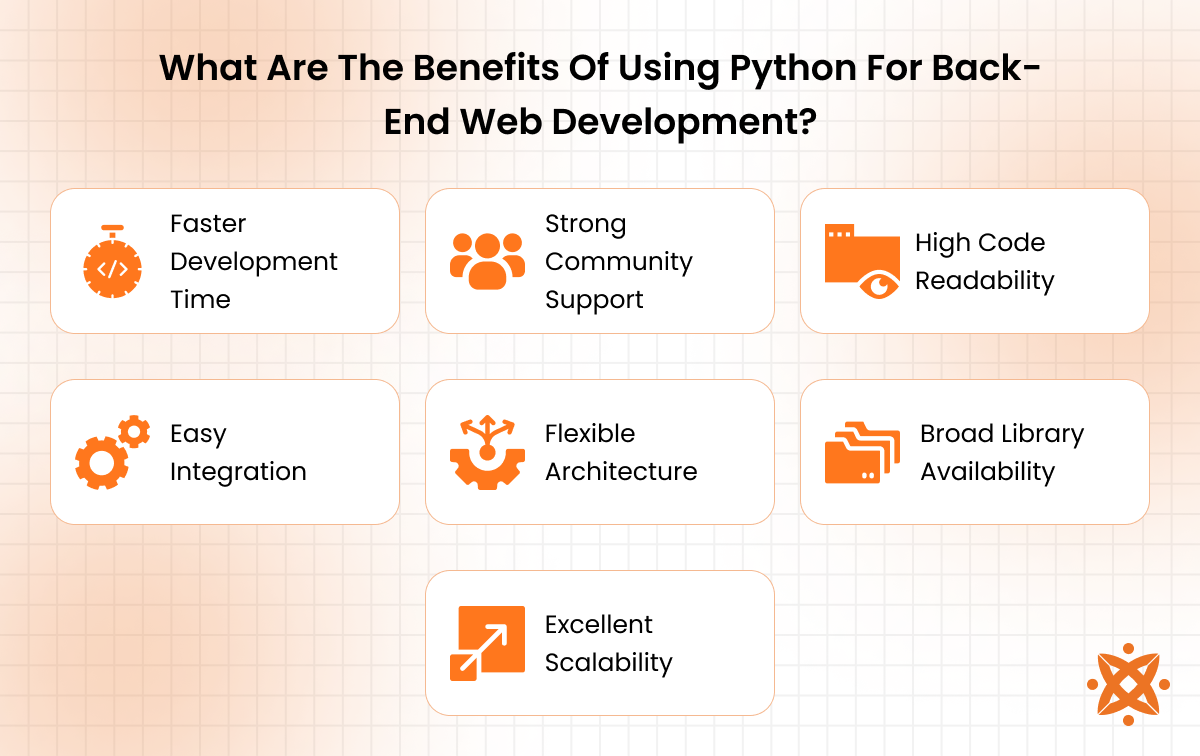
The primary benefits of using Python for back-end web development are:
The most common Python back-end frameworks include the following: Django, Flask, FastAPI, Pyramid, and Tornado. These frameworks help you create structured backend systems by handling routing, middleware, database access, and request handling through reusable components.
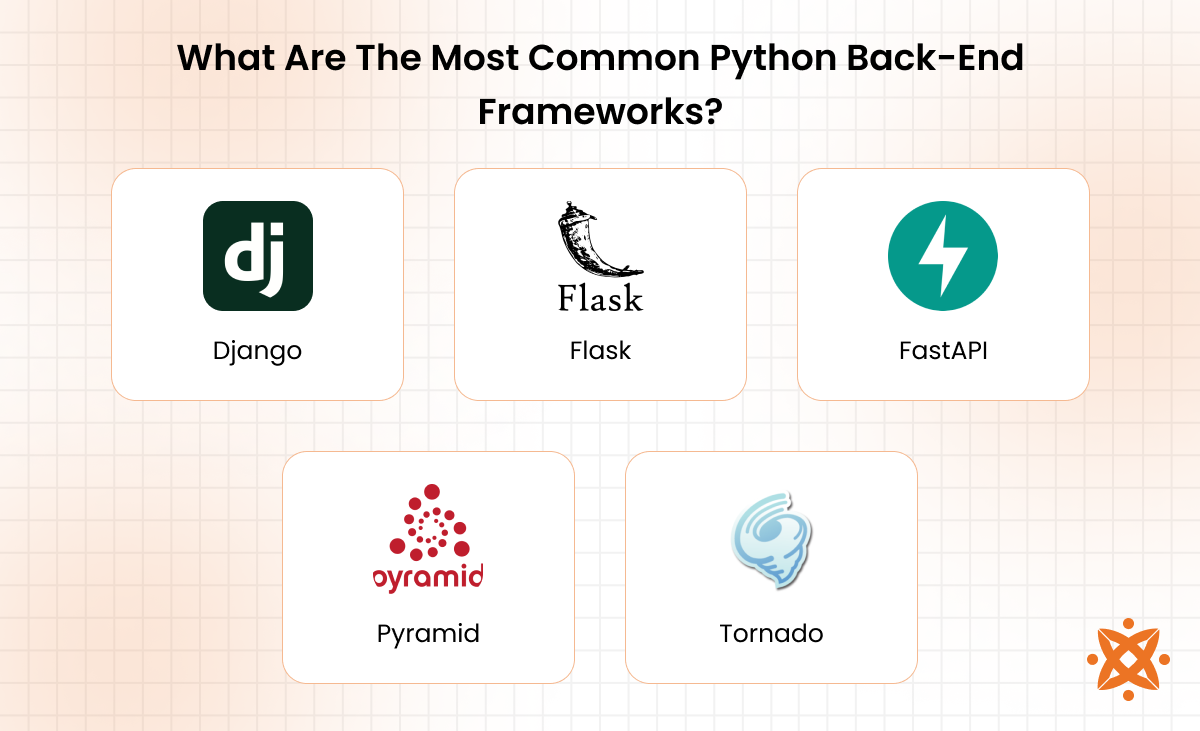
The most common Python back-end frameworks are:
Yes. Python can be used for front-end web development through tools that convert Python code into browser-compatible JavaScript. Examples include Brython, Transcrypt, Skulpt, and Pyodide. These tools allow you to write client-side code using Python syntax instead of JavaScript.
Despite these advantages, you face clear limitations. Browser support is limited, performance is slower compared to native JavaScript, and the developer ecosystem is smaller. Most front-end libraries, plugins, and frameworks are still built around JavaScript and its variants.
For smoother performance and wider compatibility, you should use a front-end tech stack that includes HTML, CSS, and JavaScript frameworks like React, Angular, or Vue.js. These tools offer strong support for UI design, real-time updates, and responsive user interfaces for front-end web development.
Python communicates with the front-end by sending and receiving data through HTTP requests using backend frameworks like Django, Flask, or FastAPI.
When a user interacts with your front-end interface, by clicking a button, submitting a form, or navigating to a page, the browser sends a request to the server. The Python backend processes that request, run the logic, queries databases if needed, and send back a response in formats like JSON or HTML.
This exchange is handled through APIs. You define endpoints in your Python application that the front-end connects to using tools like fetch or Axios. These endpoints act as bridges between the user's actions and your backend's logic.
The common technologies that Python integrates with include HTML, JavaScript, PostgreSQL, Docker, AWS, REST APIs, Redis, and Git. These tools work alongside Python to handle data storage, user interface rendering, deployment, cloud hosting, and real-time communication in back-end systems.
The common technologies that Python integrates with are:
Yes. Python is suitable for full-stack development when combined with frontend technologies like HTML, CSS, and JavaScript frameworks. You use Python to handle the server-side logic, manage databases, and build APIs, while frontend tools render the interface and handle user interaction.
Although Python isn't a browser-native language, it integrates well with full-stack environments through frameworks like Django and Flask. These frameworks let you manage both the backend and frontend logic in a single Full-Stack development project structure, especially when using templating engines like Jinja2.
Python compares to JavaScript in web development based on their roles in front-end and back-end tasks, development speed, learning curve, and ecosystem support.
The table below outlines the core similarities and differences between both languages when you're building web applications:
| Feature | Python | JavaScript |
| Primary Use | Back-end development | Front-end and back-end development |
| Front-End Capability | Limited (via tools like Brython, Pyodide) | Native browser support |
| Back-End Support | Strong (Django, Flask, FastAPI) | Strong (Node.js, Express) |
| Syntax Readability | Clear, English-like | Verbose with flexible syntax |
| Learning Curve | Easier for beginners | Slightly steeper due to async behaviour |
| Performance | Slower for front-end tasks | Faster in the browser and non-blocking servers |
| Community Support | Large, especially for data and AI | Massive, especially for web and UI dev |
| Use in Full-Stack | Common with Django + JavaScript front-end | Common to both front-end and back-end |
| Execution Environment | Server-side | Browser and server-side |
| Popular Frameworks | Django, Flask, FastAPI | React, Angular, Vue.js, Node.js |
The main difference between client-side and server-side scripting lies in where the code runs. Client-side scripting runs directly in the user's browser and controls how the webpage looks and behaves. It manages tasks like animations, form validation, and interactive features using HTML, CSS, and JavaScript.
Server-side scripting runs on a web server and handles logic that isn't visible to the user. You use it for tasks like processing forms, accessing databases, managing sessions, and delivering dynamic content. Python is used mainly for server-side scripting.
The main difference between Django and React is that Django is a back-end framework, while React is a front-end library. You use Django to handle server-side logic, database operations, and routing. It helps you build secure, scalable web applications with features like admin panels and user authentication.
React is used to build dynamic user interfaces that run in the browser. It lets you create interactive elements, manage UI states, and update content without reloading the page. You often combine both—Django for the back-end and React for the front-end—in full-stack projects.
Sign up now and get notified when we publish a new article!
Co-Founder
Oliver Baker is a co-founder of Intelivita, a leading Web and Mobile App Development Company based in Leeds, UK. Oliver has been at the forefront of the business, expanding it globally and into new technologies including iOS and Android, AR, VR and Mobile Game applications. Oliver excels in Project Management, Leadership, Quality Assurance and Problem Solving and has qualifications with Prince2 and APM. He aims to develop his skills further through a shared interest with other leaders in the Software Markets and the Clients of Intelivita.
