


Co-Founder

Gaming apps have become an integral part of modern entertainment, offering engaging experiences that range from casual puzzles to complex strategy games.
Unlike traditional video games, gaming apps are designed particularly for mobile devices and tablets, making them accessible to a wider audience.
Worldwide, the number of active gaming app users currently stands at around 3.09 billion, with projections from Exploding Topics estimating this figure will grow to 3.32 billion by 2025.
The key features of gaming apps include intuitive controls, immersive graphics, and engaging reward systems. These features enrich the player experience by ensuring smooth navigation, visually appealing environments, and motivating incentives for progress.
Most gaming apps include in-app purchases, enabling players to unlock exclusive content or upgrade their abilities, which also serves as a key monetisation strategy for developers.
The development process for gaming apps involves planning, designing, coding, testing, and launching the app.
Developers focus on crafting unique reward systems, creating visually rich environments with immersive graphics, and implementing features that cater to their target audience.
Cloud gaming apps work by leveraging remote game servers and streaming technology to deliver high-quality gaming experiences without requiring powerful hardware on the users device. These apps rely on real-time streaming protocols to transmit gameplay from servers to the player's device, with adaptive technology ensuring smooth performance across varying network conditions.
Multiplayer gaming apps operate by connecting players across the globe through internet connectivity and synchronising gameplay via centralised game servers. The system includes match-making algorithms to pair players based on skill levels and latency, as well as responsive player interfaces for interaction.
Multiplayer apps also use TCP/UDP protocols to ensure efficient data transfer and real-time responses.
A gaming app is software designed for mobile devices such as smartphones and tablets that allows users to play games.
Unlike traditional video games that are played on dedicated consoles or PCs, gaming apps are tailored to leverage mobile devices' portability and touch-based interface.
Gaming apps range from simple casual games to complex multiplayer experiences. Examples of gaming apps include Candy Crush Saga (a match-three puzzle game), Clash of Clans (a strategy game), Pokemon GO (an augmented reality game), or innovative ideas like trivia apps where players compete in real-time or apps featuring gamified learning for children.
Gaming apps differ from traditional video games in their accessibility, platform dependency, and gameplay style.
Conventional games require consoles, powerful hardware, or physical controllers. Gaming apps are lightweight, accessible to a broader audience, and monetised through in-app purchases, ads, or subscriptions. Gaming apps emphasise short, engaging sessions compared to the extended gameplay of many console or PC games.
The history of gaming apps dates back to the early 1990s, with notable milestones shaping the industry, according to Gameopedia in “The History of Mobile Gaming.” In 1997, Nokia's release of Snake made mobile gaming mainstream, as the game came pre-installed on millions of phones. In 1999, Japan's i-mode network enabled users to download more advanced mobile games.
The release of Space Invaders for mobile phones in 2001 marked a significant step toward bringing classic games to handheld devices.
The turning point came in 2008 with the launch of app stores like Apple's App Store and Google Play Store, which democratised game distribution and sparked a global mobile gaming revolution.
As of 2024, the mobile gaming market is projected to generate $98.74 billion in revenue worldwide, according to Statista, highlighting its dominance within the gaming app industry. By 2027, the number of mobile gamers is expected to reach 1.9 billion, showcasing consistent growth. In the U.S., competitive gaming thrives, with over 3,000 esports players, further reflecting the diverse appeal of gaming.
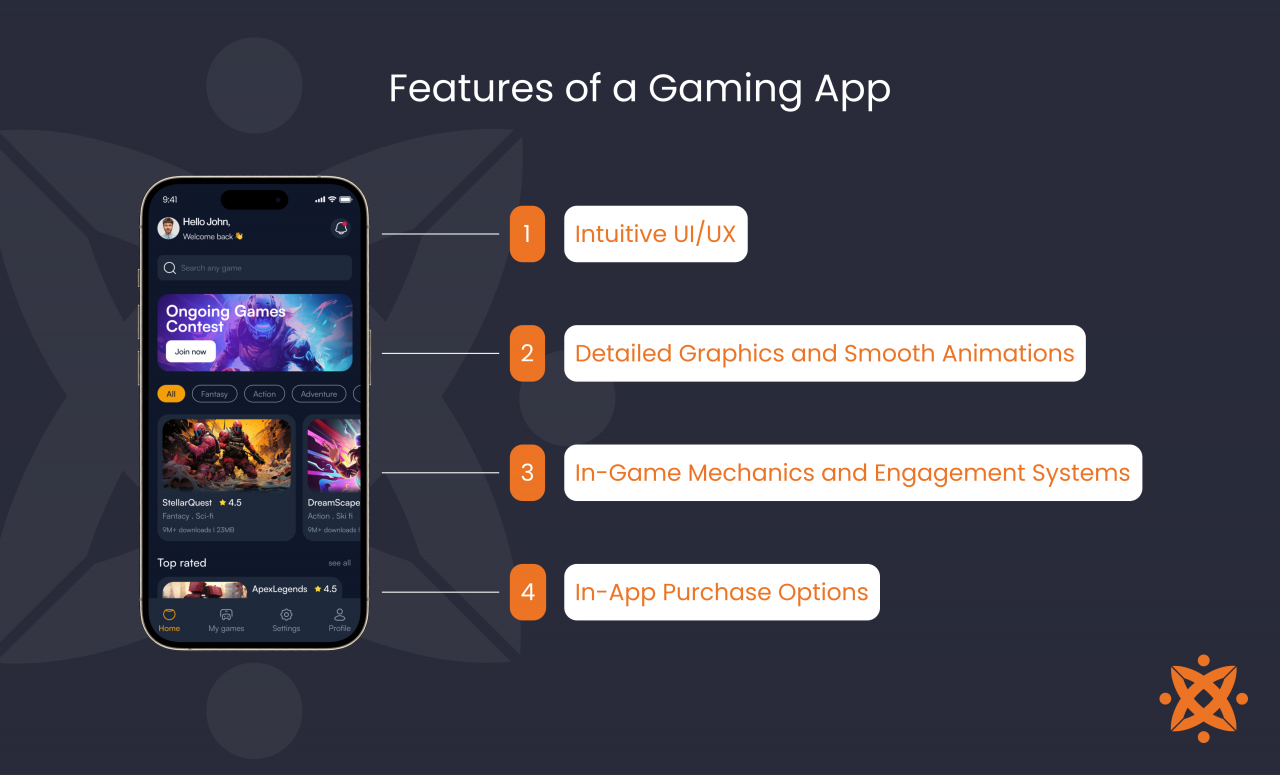
The key features of a gaming app include Intuitive and Responsive User Interface (UI/UX), Graphics and Animation, and In-Game Mechanics and Engagement Systems. These features collectively determine the user experience, visual appeal, and the app's ability to retain and engage players.
Gaming apps are designed to combine functionality with entertainment, ensuring players immerse themselves in the game world effortlessly.
The key features of a gaming app are as follows:
To develop a gaming app, you need to focus on conceptualising the game, selecting the right game engine, and implementing effective UI/UX design.
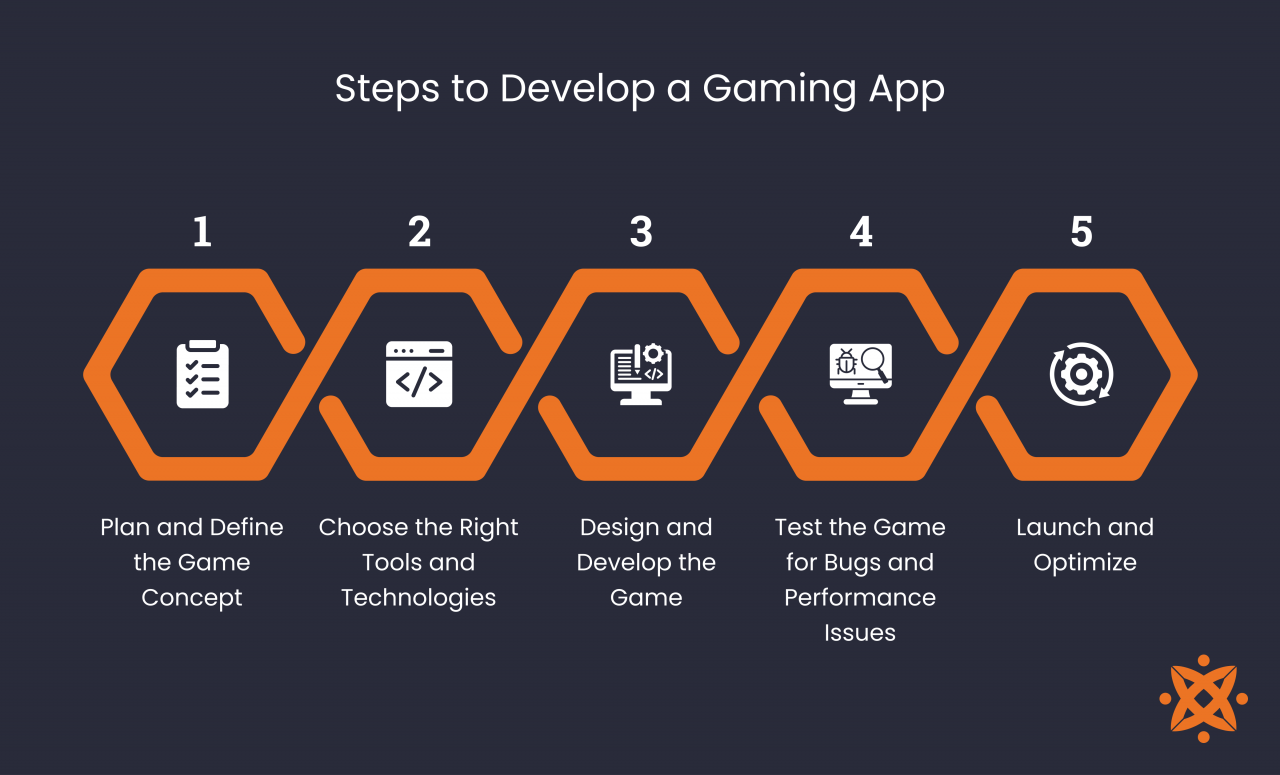
The following steps are required to develop a gaming app:
Planning begins with defining the overall vision of the gaming app, including its genre, storylines, characters, and user goals. This step sets the foundation by identifying the target audience and ensuring the concept resonates with their preferences. Developers focus on conceptualising the game by determining its unique elements, such as gameplay style, progression systems, and rewards. The process involves brainstorming ideas, mapping out the gameplay, and creating a detailed design document that guides subsequent development stages. Tools like Trello or Notion help organise ideas and streamline collaboration during this phase.
Choosing the right tools and technologies ensures the game is developed efficiently and meets performance expectations. Selecting a suitable game engine like Unity, Unreal Engine, or Godot is important, as it determines the visual quality and compatibility across platforms. Developers also decide on programming languages, such as C#, C++, or JavaScript, depending on the game’s technical requirements. Supporting technologies like middleware for audio integration and design software like Blender or Photoshop for creating game assets are also necessary. This step involves evaluating the game’s complexity and choosing tools that balance creativity and scalability.
Game design and development bring the concept to life by building game assets, implementing game logic, and crafting an engaging UI/UX. Developers design characters, environments, and animations to create an immersive experience using tools like Maya or Adobe Illustrator. They then focus on the game logic, coding rules and controls that dictate how the game operates. An intuitive UI/UX ensures smooth navigation and enriches the user experience. During this phase, assets and mechanics are integrated into the selected game engine, transforming ideas into a functional and visually compelling gaming app.
Testing the game app is important to ensure it runs smoothly across devices and provides a seamless experience. This involves identifying and fixing bugs, optimising load times, and refining controls through debugging and performance profiling. Tools like Unity Profiler or Visual Studio Analyzer help developers analyse performance metrics and eliminate inefficiencies. Beta testing with real users is compulsory for gathering feedback and identifying usability issues that do not appear during internal testing. Thorough testing guarantees a polished final product that meets user expectations.
Launching the gaming app involves releasing it on platforms like the Apple App Store or Google Play Store, followed by ongoing optimisation based on user analytics and feedback. Developers monitor user behaviour using tools like Firebase to track engagement and identify areas for improvement. Post-launch updates ensure the app stays relevant by introducing new features, fixing bugs, and optimising performance. Engaging with user feedback through reviews and surveys helps maintain a strong player base and guides future updates to improve the gaming experience.
The tools and technologies used in gaming app development include game development engines, programming languages, and asset creation and design tools. These elements work together to create visually appealing, functional, and engaging gaming experiences. Developers leverage these tools to manage everything from graphics and animations to coding and testing, ensuring the app meets both technical and creative goals.
The top tools and technologies used in gaming app development are as follows:
Game development engines include Unity, Unreal Engine, and Godot. These engines are important for 2D and 3D game development, as they provide frameworks to manage graphics, audio, and game logic. Game development engines simplify the gaming app development process, allowing developers to focus on creativity and functionality. Game engines play a pivotal role in rendering visual effects, simulating environments, and integrating physics engines for immersive gameplay.
The common game development engines are as follows:
The most commonly used programming languages in gaming app development include C++, C#, and JavaScript. These languages form the backbone of game logic, enabling developers to implement gameplay mechanics, manage graphics, and integrate artificial intelligence. Programming languages are necessary for coding interactive elements, optimising performance, and supporting cross-platform compatibility.
The most commonly used programming languages in gaming app development are as follows:
The common asset creation and design tools for gaming app development include Blender, Adobe Photoshop, and Maya. These tools are required for creating character modelling, animations, and visual effects, ensuring the game’s artistic elements align with its concept. They are also used to design detailed environments, objects, and characters, bringing creative visions to life.
The middleware and development kits for gaming app development include Havok, NVIDIA PhysX, and Photon Engine.
Middleware acts as a bridge, integrating physics engines, audio, or networking into the game without building these features from scratch. They enrich functionality, reducing development time and effort.
The middleware and development kits for gaming app development are as follows:
The common testing and debugging tools for gaming app development include Visual Studio Debugger, Unity Profiler, and Selenium. These tools help developers ensure quality assurance by identifying and fixing bugs, optimising performance, and refining the app for a seamless experience. They are important for debugging, performance profiling, and maintaining a polished final product.
The common testing and debugging tools for gaming app development are as follows:
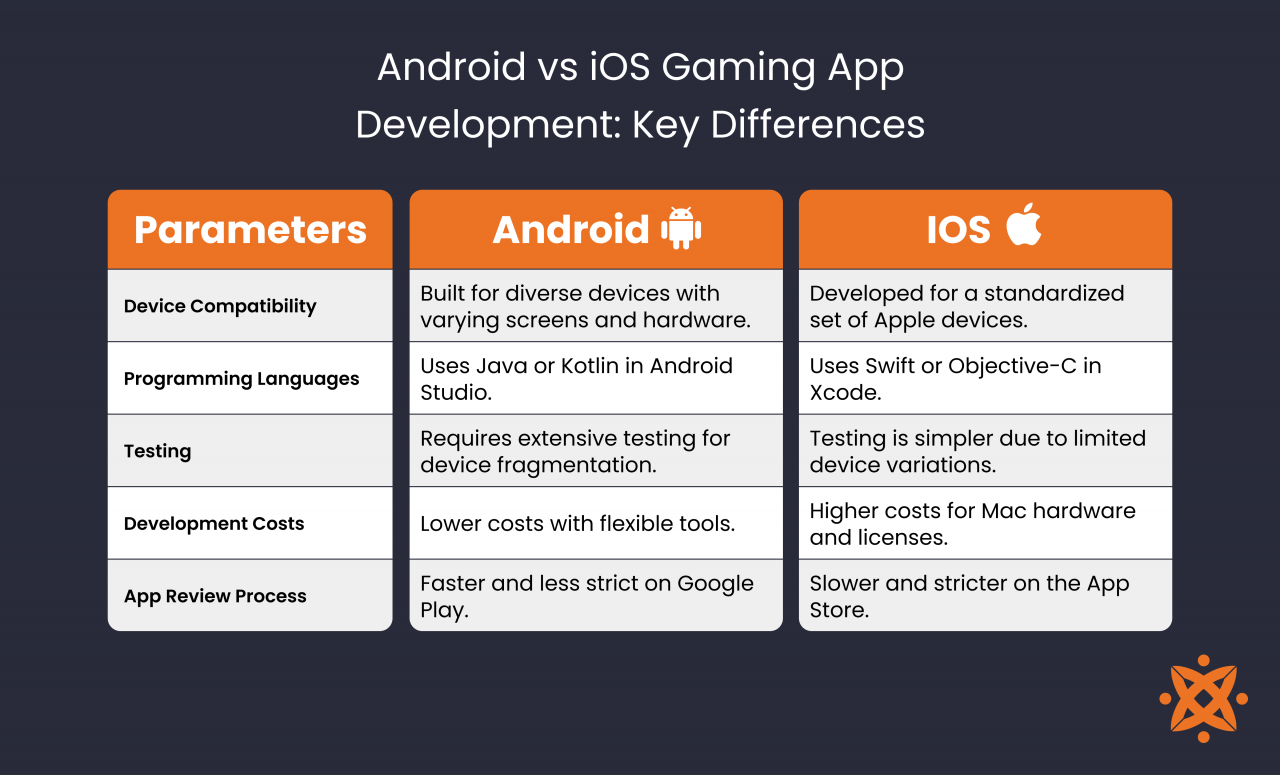
The main difference between Android gaming app development and iOS gaming app development is the operating system and platform requirements. Android apps are built for a wide variety of devices with different screen sizes, hardware capabilities, and operating system versions, making optimisation for compatibility a key challenge. In contrast, iOS apps are developed for a more standardised set of Apple devices, simplifying performance consistency but requiring adherence to strict App Store guidelines.
Other differences include the programming languages and development environments used. Android development primarily relies on Java or Kotlin and is done in Android Studio. iOS development utilises Swift or Objective-C within Xcode. Android apps must account for fragmentation, requiring extensive testing across diverse devices, whereas iOS apps benefit from Apple's limited hardware ecosystem, making testing more streamlined.
iOS development involves higher upfront costs due to the need for Mac hardware and developer licences, whereas Android development offers more flexibility in terms of tools and systems. The review process for iOS apps is more rigorous, taking longer than Android's relatively faster review process on Google Play.
Cloud gaming apps work by streaming games from remote game servers to a user’s device, allowing players to enjoy high-quality digital games without the need for powerful local hardware.
Using streaming technology, these apps deliver game visuals and audio as real-time video processing user inputs remotely. This architecture eliminates the need for game installations, relying on robust networks to maintain smooth gameplay.
Cloud gaming relies on a combination of remote game servers, client-side interfaces, and real-time streaming protocols. The servers host the games, handle processing, and render graphics, and the client side displays the stream and collects user inputs.
Advanced video codecs and adaptive bitrate streaming optimise the video quality based on the user’s available network bandwidth and ensure uninterrupted gameplay even under varying network conditions.
Streaming technology forms the backbone of cloud gaming, transmitting game visuals and audio to the user's device in real time. Through real-time streaming protocols, games are encoded on the server and decoded on the client device. This minimises data transfer but requires consistent high-speed internet to deliver smooth and high-resolution content.
Leading platforms like Xbox Cloud Gaming apps use this method to bring console-quality gaming to various devices.
In cloud gaming, input handling systems capture the player’s actions, such as button presses or joystick movements, and send them to the server for processing. The server then updates the game state and streams the response back to the user’s screen. Efficient latency reduction and response optimisation are necessary to maintain a seamless experience, ensuring that actions feel instantaneous despite the distance to the server.
Cloud gaming demands a reliable, low-latency network with sufficient network bandwidth to support high-resolution streams without interruptions. Issues such as bandwidth limitations, high latency, and geographic distance to data centres lead to delays and lower-quality visuals. A connection with low packet loss and speeds of at least 15 Mbps is recommended for smooth gameplay.
Further advancements in latency reduction technologies and more widely distributed data centres are helping to improve access and performance globally.
The best cloud gaming apps for Android and iOS include Xbox Cloud Gaming, GeForce Now, and Google Stadia, each catering to specific needs and preferences. Xbox Cloud Gaming is ideal for users already invested in the Xbox ecosystem, providing access to a vast library of games through a Game Pass subscription. Its seamless integration with Xbox accounts and reliable streaming technology makes it perfect for console-like experiences on mobile devices.
GeForce Now is best suited for gamers with a strong existing PC game library. It allows users to stream games they already own on platforms like Steam and Epic Games Store, making it a cost-effective option for PC gamers who want to play on mobile devices. Its advanced features, such as adaptive bitrate streaming, ensure smooth gameplay even with moderate internet speeds.
Google Stadia, on the other hand, is ideal for users who prefer purchasing individual games rather than subscribing to a service. It offers excellent real-time streaming protocols and minimal setup requirements, making it an accessible choice for casual gamers.
Stadia has faced challenges in expanding its game library, but it remains a good option for high-quality gaming on the go.
Each app’s performance depends on network bandwidth and low-latency networks, so users should ensure a stable, high-speed internet connection for the best experience.
Multiplayer gaming apps work by enabling real-time interaction between players across devices through internet connectivity and communication with a central game server.
The server acts as the hub where game logic, player data, and match information are processed and synchronised. Players connect to the server using their player interfaces, allowing them to interact with the game and each other simultaneously, regardless of location.
The core functionality revolves around seamless communication between players and the game server. Internet connectivity ensures that actions, movements, or commands from one player are transmitted to the server, processed, and relayed to other connected players in real-time.
This real-time interaction is powered by network protocols like TCP/UDP, which ensure data reliability and low latency, depending on the game’s requirements.
A multiplayer system includes the game server, which handles necessary processes such as game logic and synchronisation, player interfaces, which display game states and capture user inputs, and devices connected to the network. These components work together to deliver a unified experience, ensuring players see the same events occur in the game, whether they are racing, battling, or solving puzzles together.
Synchronisation is important to ensure that all players experience the same game state, such as movements, scores, or game world changes, in real-time. This is achieved by the game server, which updates and distributes the synchronised game data to all connected players.
Matchmaking, another integral feature, uses algorithms to pair players based on skill level, geographic location, and latency to ensure fair and balanced matches. Protocols like UDP are used for faster data transmission in competitive or fast-paced games. TCP is preferred for more data-sensitive operations, such as chat or turn-based games.
Gaming apps that allow players to earn real money include Skillz, Mistplay, and Lucktastic. These apps provide a platform where users participate in competitive games or play casual games to earn cash or prizes.
Skillz, for example, enables players to compete in skill-based tournaments with a chance to win cash prizes. Players use their winnings to cash out or continue playing.
Mistplay rewards users for playing mobile games with gift cards and other rewards.
Lucktastic, on the other hand, allows players to win real money by playing free scratch card games and other prize-based activities. These apps make money by offering advertisers the ability to promote their brands within the games, and a portion of that revenue is shared with players.
Gaming apps monetise player skills by implementing features like in-app purchases, paid tournaments, and reward systems. Apps offer a freemium model, where players download and play the game for free but are encouraged to spend money on premium content, such as skins, power-ups, or exclusive tournaments.
Competitive gaming apps, such as Skillz, require players to pay an entry fee to participate in tournaments where they can win real money.
Apps also generate revenue through advertising and sponsorship deals, offering players a chance to earn rewards by watching ads or engaging with partner content.
The best gaming apps for Android and iPhone are PUBG Mobile, Fortnite, and Candy Crush Saga. PUBG Mobile and Fortnite offer immersive multiplayer experiences with high-quality graphics and engaging gameplay. Both are free to play but include in-app purchases for cosmetic items, passes, and other upgrades.
Candy Crush Saga is a popular puzzle game that has become a staple in casual gaming, offering addictive gameplay with monetisation options through in-app purchases for boosts and extra lives. These apps dominate both platforms due to their wide appeal and regular content updates, ensuring a constantly fresh experience for players.
The main difference between Android gaming apps and iPhone gaming apps is the operating system and hardware constraints. Android apps are developed for a diverse range of devices, which vary greatly in terms of processing power, screen sizes, and system versions. This requires developers to optimise games for a wide range of hardware.
In contrast, iPhone apps are developed for a more standardised set of Apple devices, offering more predictable performance but requiring adherence to strict design and approval guidelines set by Apple.
Android development uses Java or Kotlin, whereas iOS apps are built with Swift or Objective-C, resulting in differences in coding structure and development environment.
The costs associated with developing a gaming app range from $5000 to millions of dollars, according to Apptunix. The cost varies significantly depending on the complexity of the game, the platform, and the development team.
For a simple mobile game, development costs between $5,000 and $50,000, whereas more complex games with high-end graphics, multiplayer features, and custom-built components cost millions of dollars.
Key factors that affect costs include game design, development tools, licensing fees, artwork, sound design, testing, and the integration of third-party services like analytics or payment systems. Ongoing maintenance and updates also add to the total cost of ownership.
The latest trends in gaming apps include the rise of cloud gaming, augmented reality (AR), and artificial intelligence (AI) integration. Cloud gaming allows users to play high-quality games without the need for powerful hardware, instead relying on servers to process the games and stream them to mobile devices. AR has gained popularity with games like Pokémon Go, providing immersive, location-based experiences.
AI is being increasingly used for smarter NPCs, procedural game generation, and personalised gaming experiences. Cross-platform gaming is becoming more common, enabling players to game seamlessly across multiple devices, whether smartphones, PCs, or consoles.
The role of AI in gaming apps is multifaceted, enhancing both gameplay and development. AI is used to create smart NPCs (non-player characters) that react intelligently to player actions, making the gaming experience more immersive. It is also utilised for procedural generation, creating new and unpredictable content, such as levels, maps, or game environments, to keep players engaged.
AI helps improve personalisation, offering tailored game experiences based on player behaviour, such as recommending new games or in-game purchases. In competitive gaming, AI analyses player performance, adjusts difficulty levels or provides real-time feedback.
The measures that protect user data in gaming apps include encryption, two-factor authentication (2FA), and privacy policies. Encryption secures sensitive information, such as player credentials and payment details, during transmission between the app and servers.
Two-factor authentication adds an extra layer of security, requiring players to verify their identity using both their password and a second method, such as a text message code.
Gaming apps must comply with privacy policies that outline how user data is collected, stored, and shared, ensuring users' rights are protected in accordance with regulations like GDPR and CCPA.
Yes, you can run some gaming apps on a Raspberry Pi 4, though the performance varies depending on the game and the app's hardware requirements. The Raspberry Pi 4 is equipped with a relatively powerful processor and sufficient RAM for many light or retro-style games, including those that use emulators to run older console games.
For more graphically demanding modern gaming apps, such as PUBG or Fortnite, the Raspberry Pi 4 struggles due to its limited GPU and processing power compared to dedicated gaming consoles or PCs.
To choose a gaming app development company, first, evaluate their portfolio of previous work to ensure they have experience with the type of game you want to develop.
Look for companies that specialise in the specific platform you're targeting (iOS, Android, or cross-platform) and have experience with relevant game engines, like Unity or Unreal Engine.
Check for strong expertise in key areas like game design, user interface (UI/UX), network integration, and monetisation strategies.
A good gaming app company like Intelivita is transparent about project timelines and cost estimates and provides a clear communication process for ongoing development. Referrals and user feedback on past projects also help you assess the credibility of a gaming app company.
Sign up now and get notified when we publish a new article!
Co-Founder
Hey there. I am Dhaval Sarvaiya, one of the Founders of Intelivita. Intelivita is a mobile app development company that helps companies achieve the goal of Digital Transformation. I help Enterprises and Startups overcome their Digital Transformation and mobile app development challenges with the might of on-demand solutions powered by cutting-edge technology.
